
When will the belly grow, what symptoms will appear in which week — these are the questions that new mothers have in their minds. All the questions about first trimester pregnancy belly week by week are answered in simple language in this article.

Since the news of pregnancy, mothers have been thinking about one thing. Is the belly slowly growing? How is the little baby inside now? It is not wrong for these questions to come to mind, but these thoughts keep a mother alert and aware.
“First trimester pregnancy belly week by week” refers to understanding what changes occur in the belly and body in the very first 12 weeks of pregnancy. In European countries such as the UK, Germany, France or the Netherlands, new mothers keep in touch with their midwife or GP from the moment they find out about their pregnancy.
In this article, we will know in very simple language — what happens to the belly in which week, which symptoms are normal, and when it is necessary to go to the doctor.
The first 12 weeks — how important is this time?
Pregnancy lasts a total of 40 weeks. These 40 weeks are divided into three parts. The first part is considered from weeks 1 to 12 — this entire period is called the first trimester. This time is the most delicate because the baby’s brain, heart, hands and feet all start to form during this time. There’s no way to tell, but something is happening inside every moment.
What kind of hormonal changes occur in the body during this time?
As soon as you get pregnant, a hormone called HCG suddenly increases in your body. This hormone is what causes all the problems. You feel nauseous, your chest hurts a little, you lose interest in food, and you feel sleepy all day. Actually, it’s not a problem with your body — your body is telling you that it’s getting ready for someone new to come inside.
Does the stomach come out late if it is a first-time mother?
Yes, usually the stomach appears a little late if it is a first-time mother. This is because the abdominal muscles are new to this experience, so they hold it tightly. Women who have been mothers before have a slightly softer muscle mass, so their stomachs protrude earlier. There is nothing to worry about.
Is there a problem with the baby if the stomach does not protrude?
Many mothers have this misconception. In fact, the size of the stomach does not indicate the health of the baby. A small stomach does not mean that the baby is not small. Every mother’s body is different, so the size of the stomach will also be different — this is normal.
How does the belly change week by week?
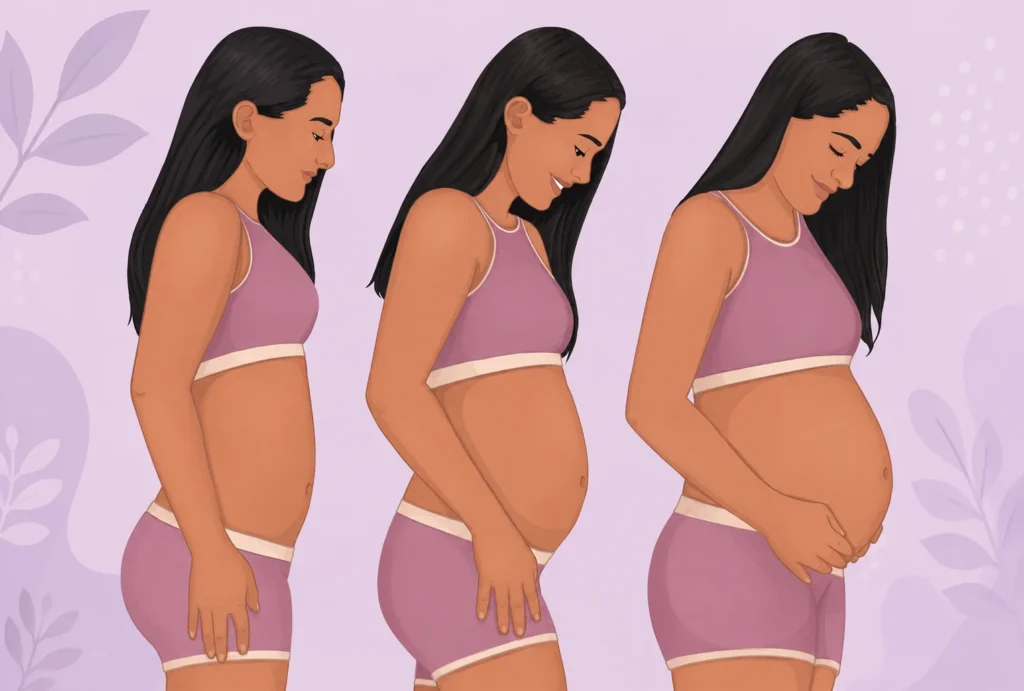
To learn about “first trimester pregnancy belly week by week”, you need to understand each week separately. Each week, something different happens inside the body, and the appearance of the belly also gradually changes on the outside. In the beginning, all the changes are so small that you can’t see them unless you look for them yourself. But by weeks 10-12, you can feel at least a little that the body is changing.
Weeks 1 to 4 — The belly is completely silent
During these four weeks, no changes are visible from the outside in the belly. The baby is just like a small seed. The uterus is still in the shape of a small pear. The belly fabric fits as before, nothing is noticeable. However, the body has started working properly inside.
What feelings can you have in weeks 1-4?
There may be a slight pulling pain at the very bottom of the belly, like the pain before a period. Light spotting or blood stains may appear, this is called implantation bleeding. The body may suddenly feel more tired. You may also feel a heaviness or slight pain in your chest.
Weeks 5 to 8 — Gas and Bloating
Many mothers think their stomach is getting bigger during this time, but in fact it is mostly due to gas or bloating. Hormonal changes slow down digestion, causing gas to build up in the stomach and making the stomach look a little round. Clothes start to feel a little tight. Nausea is the most bothersome during this time.
Weeks 9 to 12 — The real changes begin
At this time, the uterus starts to rise above the pubic bone. Then, if you put your hand on the lower abdomen, it feels a little hard. By week 12, the baby is about the size of a lemon. Outsiders will not be able to tell unless someone close to you shows it, but the mother herself will know that something is happening.
Explore more here: signs your pregnancy is going well in the first trimester
Comparison of baby size and belly size by week
It is easy to understand how much the baby is developing and what the belly looks like each week. The table below has been created to make it easy to understand at a glance. Remember, this is an average calculation — there may be slight differences in each mother’s case.
| Week | Baby Size | Belly Condition | Main Feelings |
| 1–4 | Like poppy seeds | No change | Mild cramps, fatigue |
| 5–6 | Sesame-sized | Gas bloating | Nausea and vomiting begin |
| 7–8 | Like kidney beans | Clothing a little tight | Excessive vomiting, fatigue |
| 9–10 | Like a grape | Lightly hard at the bottom | Chest pain decreases |
| 11–12 | Like a lemon | Slight bumps may appear | Takes a little relief |
Which symptoms are normal in the first trimester and which ones should you see a doctor for?
This question comes to every new mother’s mind. Not all symptoms mean a problem, but there are some symptoms that should prompt you to see a doctor without delay. In European countries, midwives always say — call if in doubt, there’s nothing to be ashamed of.
How normal is morning sickness?
Morning sickness is the most common problem of the first trimester. Vomiting or feeling nauseous once or twice a day is completely normal. Eating small amounts repeatedly, drinking ginger tea or lemon water can provide relief. However, if you vomit more than five or six times a day, cannot keep anything down, or lose weight rapidly, you should see a doctor immediately.
What you need to know about mental health in the first trimester
At the beginning of pregnancy, not only the body but also the mind is not the same as before. One day you feel very happy, the next day you cry for no reason. It’s not weakness — it’s because of hormones. Many mothers in Europe are embarrassed to talk about this, but it’s actually a completely normal thing. It’s not just about taking care of your body, you also need to pay equal attention to your mind. Talk to your family, don’t try to carry everything alone.
Is it normal to have mood swings?

Yes, it’s completely normal. Progesterone and Estrogen hormones suddenly increase a lot in the first trimester. These hormones directly affect the brain. So even if you’re happy in the morning, you may feel sad in the afternoon. You may get angry over small things, or you may cry for no reason. If your family members don’t understand this, explain it to them.
What to do if you have anxiety or worry?
Many mothers think — is the baby okay? Is there anything wrong? These thoughts are normal to come to mind. But if you’re just immersed in these thoughts all day, it also affects the body. Do light yoga or breathing exercises. Read a book, watch something you like, take a walk outside. In many European countries, special mental health support is available for pregnant mothers, take it if necessary.
How to maintain a relationship with your partner?
It is very important to talk openly with your partner during this time. Tell him what is hurting you, what you need. Many mothers keep quiet when they are hurting themselves, thinking what will happen. But at this time, the help and support of their partner gives the mother a lot of strength.
Sleep problems and solutions in the first trimester
“first trimester pregnancy belly week by week” Sleep problems are familiar to many in the journey. On the one hand, you feel tired all day, on the other hand, you don’t sleep properly at night. When these two come together, both the body and mind become tired.
Skin and hair changes in the first trimester
Many people do not know that pregnancy not only causes changes in the stomach, but also in the skin and hair. Some people notice that acne has suddenly increased on the face, while others see that the skin has become brighter than before. Some people’s hair becomes thicker, while others lose more. Hormones are the root cause of all this. Don’t worry — most problems will subside by the end of the trimester.
What kind of changes can occur in the skin?
Sudden acne can appear on the face, especially on the cheeks and chin. This is due to the hormone Progesterone. Many people’s skin also becomes oilier than before.Keep your face clean morning and night with a mild face wash. However, do not apply any harsh creams or medications to your face without consulting a doctor.
Is hair loss or hair thickening normal?
Both can happen. Some people experience more hair loss in the first trimester, while others experience thicker and shinier hair. It depends on how the body’s hormones react. If you have hair loss, avoid rubbing your head, use a soft comb, and eat nutritious foods.
Conclusion
“first trimester pregnancy belly week by week” — This path is different, unique, completely individual for every mother. Some belly comes out early, some late. Some suffer from a lot of vomiting, some feel almost nothing. This is normal, this is beautiful.
Don’t be upset if your belly doesn’t show in the first trimester. But inside, a lot is happening every day. The baby’s little heart is beating, arms and legs are forming, the brain is developing. Listen carefully to your body at this time.
Health care is very accessible for those living in Europe. Get checkups on time, keep in regular contact with your midwife or GP. If you have any doubts or fears, don’t sit quietly and ask immediately. This is your right.
Knowing about first trimester pregnancy belly week by week doesn’t just mean seeing changes in your belly — it means getting to know your body, getting acquainted with the miraculous journey of your baby. This knowledge will make you calmer, more confident. Eat nutritious food, walk lightly, get enough sleep.
Best wishes to you and your little guest.