

There was a time when your child would return from school, open the door, and immediately start sharing stories about their day—what happened with friends, what someone said at school, what they had for lunch—they wanted to tell you everything. But is that familiar scene beginning to change?
Perhaps your 10 or 11-year-old now comes home from school and heads straight to their room, closing the door behind them—or, when asked about their day, simply replies, “Nothing happened!”
Naturally, this might lead you to wonder: is your child drifting away from you, or are they simply growing up?
In truth, the period between the ages of 9 and 12 is a time of significant transition in a child’s life. Their bodies change, their way of thinking evolves, friendships become increasingly important, and they begin to develop a desire to make their own decisions. During this phase, a good “tween parenting guide“ can be an invaluable resource for parents, helping them understand their child’s behavior and providing the support they need.

However, keep in mind that allowing your child to grow up does not mean leaving them to navigate things entirely on their own. Instead, it is about granting them a bit more independence while simultaneously creating a safe space—a place where they feel secure enough to return to you whenever they make a mistake, feel afraid, or are simply feeling down.
Understanding Your Growing Tween
Children between the ages of 9 and 12 are generally referred to as “tweens.” However, not all children develop at the same pace. Some may begin to seek their own personal space as early as age 8, while others might still prefer spending time with their parents just as they did when they were younger, even at the age of 12 or 13.
At this age, you may easily notice certain changes in your child:
- Becoming more conscious of their own room and personal belongings.
- Placing greater importance on the opinions of friends.
- Developing an interest in clothing, hairstyles, and their own appearance.
- Questioning some of the rules set by parents.
- Attempting to make their own decisions.
- Experiencing mood swings—ranging from great joy to becoming easily irritated.
Seeing these changes does not necessarily mean that your child is becoming disobedient. Often, these are simply a normal part of the growing-up process.
Why Parenting Tweens Feels Different
When your child was younger, you had to make most of the decisions—what they would eat, when they would sleep, and which toys they would play with. Now, however, they want to express their own preferences. Sometimes they may disagree with your choices, and at other times, they might insist on doing things their own way.
This is where a new chapter of parenting begins.
At this stage, the primary goal of “Tween Parenting Guide” is not to exert total control over your child, but rather to teach them the skills needed to make sound decisions.
For instance, suppose your child forgets to complete a school project. You could scold them immediately; but if, instead, you ask, “How do you think you could remember to do it next time?” you give them an opportunity to reflect on their own mistake.
These small, everyday experiences help them learn to become responsible.
What Happens Inside Your Tween’s Brain
Why does your child sometimes make excellent decisions, yet at other times—perhaps to prove something to their friends—do something bizarre? This is partly due to how their brain is developing.
According to the National Institute of Mental Health (NIMH), the adolescent brain undergoes significant changes. In particular, the prefrontal cortex—the area responsible for planning, setting priorities, and making decisions—matures relatively late.
At the same time, relationships with friends and social experiences take on increasing importance.
Consequently, your child might sometimes prioritize what their friends will think over their own safety or long-term well-being.
In such situations, avoid simply telling them, “You don’t understand anything!” Instead, calmly help them consider the potential consequences of a decision before they make it.
Body Changes and Puberty During the Tween Years
Is your child suddenly becoming more concerned about their appearance? Are they no longer happy with the clothes they used to like? Are they asking questions about changes in their body?
These could be early signs of puberty.

Puberty is a natural process during which a child’s body gradually transitions toward adulthood. According to the National Institute of Child Health and Human Development (NICHD), puberty typically begins between the ages of 8 and 13 for girls, and between 9 and 14 for boys.
However, every child’s body is different; therefore, please do not compare the changes your child is experiencing with those of other children.
Common Puberty Changes in Girls and Boys
During puberty, changes occur in the bodies of both boys and girls. However, some of these changes may differ.
| Changes | Girls | Boys |
| Growth | Height increases rapidly | Height increases rapidly |
| Body Hair | Underarm and pubic hair may appear | Facial, underarm and pubic hair may appear |
| Skin | Acne may develop | Acne may develop |
| Body Shape | Hips may become wider | Muscles may develop |
| Other Changes | Breast development and menstruation | Voice may become deeper |
You should never shame your child or make fun of them regarding these changes. These bodily changes might feel new to them; therefore, explain in simple terms that they are completely normal and a natural part of growing up.
How to Start Conversations About Puberty
Many parents believe that sitting down with their child just once to explain everything about puberty is sufficient. In reality, however, a series of smaller, informal conversations can be far more effective.
For instance, if your daughter asks about menstruation for the first time, avoid alarming her. Instead, explain that it is a natural bodily change and show her how to use a sanitary pad, should the need arise.
Similarly, with your son, discuss topics like physical development, voice changes, the growth of body hair, and personal hygiene in a natural, matter-of-fact way.
Keep a few points in mind during these conversations:
- Use the correct anatomical terms for body parts.
- Listen carefully to your child’s questions.
- Never treat any question as ridiculous or a source of shame.
- If you don’t know the answer, look for reliable information together.
- Reassure your child that asking questions about their own body is completely normal.
Ultimately, you want your child to feel comfortable coming to you first whenever they feel concerned about changes in their body. Building this level of trust is a crucial aspect of effectively Tween Parenting Guide.
Talking to Your Tween So They Keep Talking
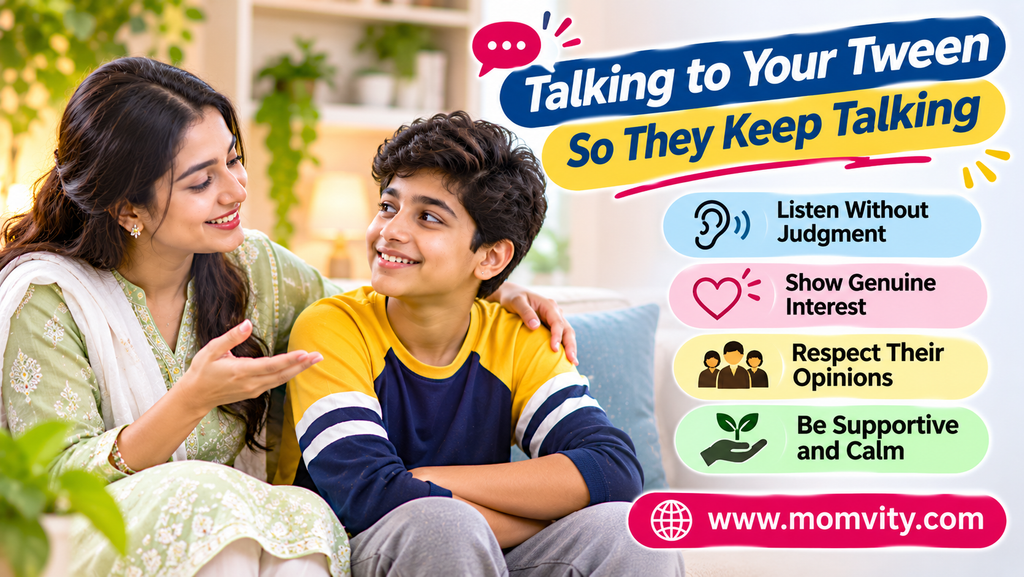
When your child doesn’t want to open up, do you find yourself asking questions repeatedly—”What’s wrong?”, “Why are you so quiet?”, “Did something happen at school?”
Even though your intentions are good, asking the same questions over and over can be annoying. At this age, children often feel uncomfortable answering direct questions.
So, how can you improve communication with them?
Start by letting them know that your goal isn’t just to solve their problems, but also to understand how they are feeling.
Listen First and Give Advice Later
Suppose your child comes home from school and mentions that their best friend is now spending more time with someone else. To you, this might seem like a trivial matter, but for your child, it could be a source of significant distress.
In such a moment, avoid saying, “Why are you upset over something so small?”
Instead, try saying, “I can see that you’re feeling down. Would you like to tell me what happened?”
Then, listen attentively.
You don’t need to provide an immediate solution to every problem. Sometimes, a child simply wants someone to listen to them and acknowledge the importance of their feelings.
Best Moments to Talk With Your Tween
It is not always necessary to sit face-to-face to have a conversation. Many children feel more comfortable talking while engaged in an activity side-by-side.
For example:
- While walking together.
- During a car ride.
- While cooking or doing small household chores.
- In a calm environment before bedtime.
- While playing a game together or watching a favorite show.
During these moments, avoid asking questions in a forced or demanding way. Instead, try to understand their feelings through natural, casual conversation.
Also, keep in mind that if your child shares a difficult or embarrassing experience with you, do not react with anger. If they feel that telling the truth will only lead to being scolded, they may choose not to share anything with you in the future.
Building Independence and Responsibility Step by Step
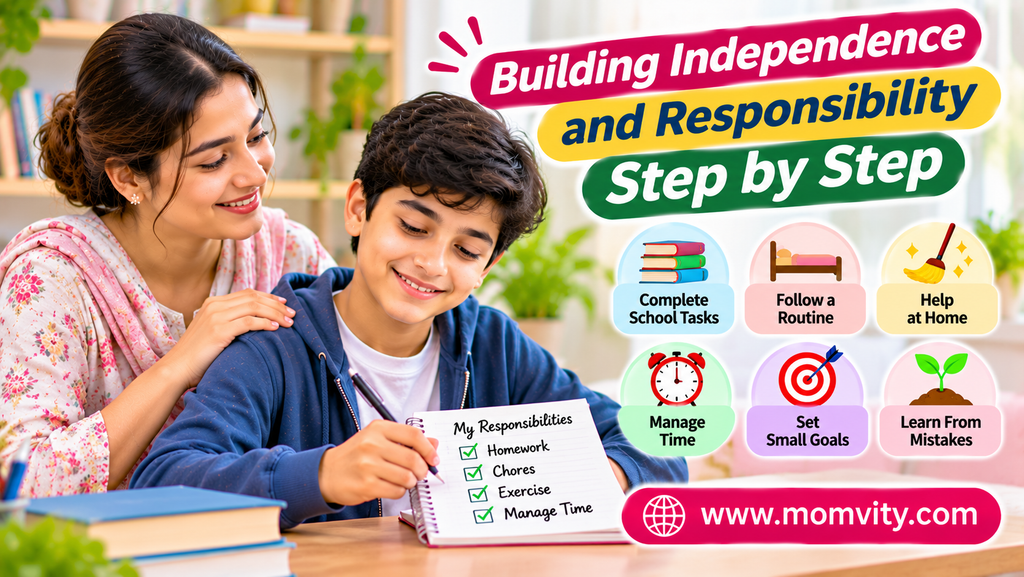
Your child is growing up. They now want to do things on their own, go out with friends, and make decisions based on their own preferences. This is natural.
But how much freedom should you grant?
On one hand, excessive control denies them the opportunity to make their own decisions. On the other hand, granting complete freedom without any rules can lead to issues regarding safety and responsibility.
Therefore, freedom should be granted gradually, taking into account your child’s age and level of maturity.
Small Responsibilities That Build Confidence
To begin with, you can assign them small household tasks:
- Packing their own school bag.
- Creating a study schedule.
- Organizing their own room and books.
- Keeping track of a set amount of pocket money.
- Choosing their own clothes.
- Offering their opinion on minor family decisions.
If a task is done incorrectly, do not immediately take over the entire responsibility yourself. Instead, let them figure out how to set things right after a mistake.
| Responsibility | First Step | Next Step |
| Schoolwork | Use a homework checklist | Plan weekly assignments |
| Money | Manage a small allowance | Save for a chosen item |
| Household Tasks | Organize personal belongings | Help with simple chores |
| Food | Choose a healthy snack | Prepare a simple meal with supervision |
| Time Management | Follow a daily routine | Plan study and free time |
Managing Screens, Smartphones and Social Media
In today’s world, it is impossible to completely separate technology from children’s lives. Smartphones, tablets, and the internet are frequently used for various purposes, including education, entertainment, and communication.
However, problems arise when screen time gradually begins to encroach upon time that should be spent on sleep, physical activity, studies, and interacting with family.
A 2026 study conducted in the United States by Common Sense Media revealed that children aged 9 to 12 spend, on average, about 5 hours a day using screens for entertainment. The same study found that 24% of 9-year-olds, 47% of 10-year-olds, and 57% of 11-year-olds own their own smartphones.
It is important to note, however, that these statistics are based on research involving children in the United States. The same patterns cannot necessarily be assumed to apply to all children in Bangladesh or other countries.
When Is the Right Time for a First Phone?
This is a common question among many parents: should you give your child a phone at age 10, or should you wait until they are 12?
There is no single, universal answer. You must consider your child’s individual needs, their sense of responsibility, and their ability to use technology safely.
Before giving them a phone, consider the following:
- Can they follow family rules?
- Will they tell you if they receive any uncomfortable or inappropriate messages?
- Can they turn off the phone at designated times?
- Do they understand the risks of sharing personal information online?
- Can they exercise caution when interacting with strangers?
The American Academy of Pediatrics (AAP) suggests that when providing a child with their first phone, you should clearly outline your family’s rules and expectations. Having a phone does not automatically grant permission to use social media.
According to the AAP, it is best to wait until a child is at least 13 years old before allowing them to create accounts on social media platforms like Instagram, Snapchat, or TikTok. Even then, it is essential to consider your child’s personal level of maturity.
Everyday Health Basics for Growing Tweens
Beyond a child’s academics, friendships, phone use, and other responsibilities, their day-to-day health is equally important.
Often, parents focus primarily on good grades or behavior. However, a lack of sufficient sleep, nutritious food, and regular physical activity can negatively affect a child’s concentration and mood.
Therefore, a guide for parenting pre-teens should also place significant emphasis on daily health habits.
Friendships, Mood Swings and Big Feelings

Is your child suddenly wanting to spend more time with friends? Are they having disagreements with a friend they used to play with every day? Do they sometimes get deeply hurt by a seemingly small remark?
At this age, friendships become increasingly important. What friends think, who includes them in a group, and who chooses to exclude them—all of these can have a significant impact on a child.
In particular, being left out of a group chat or having friends stop talking to them can make a child feel all alone.
How to Handle Friendship Problems
If your child tells you about a problem with a friend, do not immediately go to that friend’s parents to lodge a complaint.
First, try to understand the situation.
You could ask them, “What would you like right now? Should I just listen, or shall we look for a solution together?”
This simple question will help them articulate what they need.
However, if the situation involves bullying, threats, humiliation, or persistent harassment, you must take the matter seriously. If necessary, speak with the school authorities.
When Should You Contact a Pediatrician?
Not all changes are normal. Sometimes, a child’s behavior may exhibit signs that require professional advice.
According to the American Academy of Pediatrics, key indicators of depression in children include feeling sad or irritable for longer periods than usual, and losing interest in activities they once enjoyed.
Pay particular attention to the following:
- Feeling sad or excessively irritable for several weeks.
- Withdrawing from friends, sports, or previously enjoyed activities.
- Significant changes in sleeping or eating habits.
- A sudden decline in academic performance.
- Persistent reluctance to attend school.
- Expressing very negative thoughts about oneself.
- Talking about self-harm or suicide.
If you notice such changes, do not blame the child. Listen to them calmly and seek advice from a pediatrician or a child and adolescent mental health specialist.
If a child speaks about suicide or self-harm, treat it as an emergency. Do not leave the child alone, and immediately seek help from local emergency medical services or the nearest hospital.
Conclusion
As a child grows, their world gradually expands. The child who once held your hand while walking now wants to make their own decisions. The child who used to share stories about their school day might now prefer to keep some things to themselves.
It is natural to feel hurt by this. But remember, just because your child seeks independence, it does not mean that your love or your importance in their life is diminishing.
Instead, what matters most during this phase is being there for them, listening to what they have to say, allowing them to learn from their mistakes, and setting boundaries when necessary.
While no Tween Parenting Guide can offer a magical solution to every problem, such resources can help you understand how to support your child as they grow.
You don’t need to be a perfect parent every single day. There will be times when you make mistakes, times when your child doesn’t understand you, and moments when you simply disagree. But always strive to mend and nurture the relationship.
Ultimately, your child won’t just remember the rules you set. They will remember that you listened when they were feeling down, allowed them to learn from their mistakes, and stood by their side during difficult times.
May love, patience, and trust be your greatest strengths as you accompany your child on their journey of growing up!
Frequently Asked Questions
What Age Is Considered a Tween?
Children between the ages of 9 and 12 are generally referred to as ‘tweens.’ However, this age range may vary slightly depending on a child’s physical, mental, and social development.
What Is the Hardest Part of Parenting a Tween?
The greatest challenge lies in granting a child independence while simultaneously ensuring their safety. At this age, children want to make their own decisions, yet their decision-making skills are still in the process of developing.
How Much Sleep Does a Tween Need?
Children aged 6 to 12 years need 9 to 12 hours of sleep every day. Establishing a regular sleep schedule makes it easier to maintain a balance between rest and daily activities.
When Does Puberty Usually Start?
Puberty can generally begin between the ages of 8 and 13 for girls, and between 9 and 14 for boys. However, the timing of development varies for each child.
Should a 10-Year-Old Have a Smartphone?
There is no single, definitive answer to this. The decision should be made by taking into account the child’s needs, their sense of responsibility, their ability to understand safety, and their habit of following family rules.