

To learn more about the Stages Of Labor in detail, read our article about the symptoms, duration, and what to expect during labor.
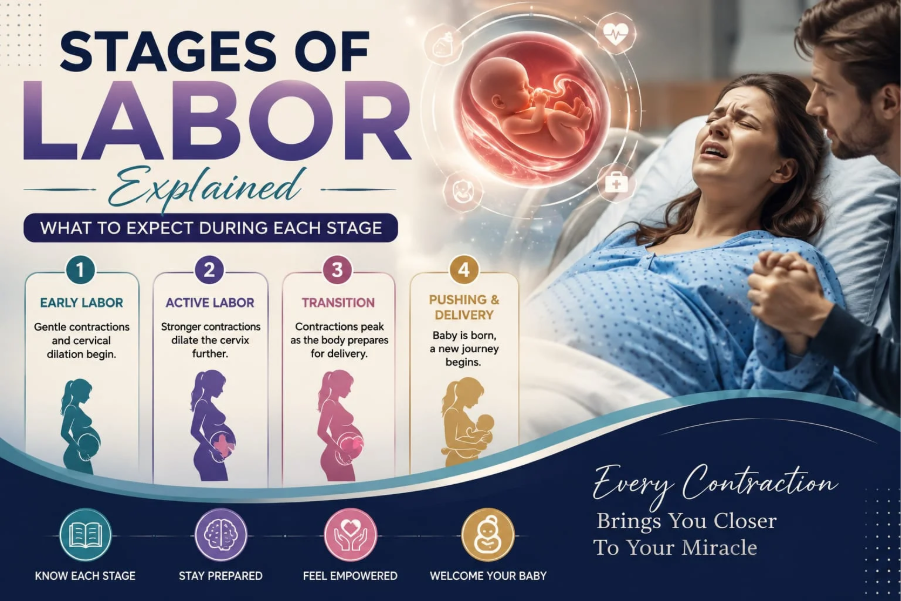
Have you ever wondered what exactly happens to the body during labor and what to expect at each stage?
During this time, the body gradually prepares for labor and at one stage, various physical changes may occur, such as regular contractions, changes in the cervix, and the baby’s downward movement. For some, the process progresses relatively quickly, while for others it may take longer. Therefore, not only the intensity of pain, but also other body signals and doctor’s advice are important.
But can knowing which changes are normal during labor and when to be extra cautious make a mother more prepared and confident?
In reality, different types of physical sensations and changes may occur at each stage of labor. At first, contractions may be slow and regular, but later they may become stronger and more frequent. Then, important steps such as the birth of the baby and the subsequent expulsion of the placenta take place. Having an idea of these things in advance can help reduce fear or anxiety in unexpected situations.
Knowledge and preparation eliminate fear, and the right decision at the right time is the biggest help on the path to a safe delivery.
Learn More About Labour and birth
Basic Understanding Of The Childbirth Process

Stages Of Labor is an important concept for understanding the sequential stages where the body gradually prepares for the birth of the baby. Knowing what changes can occur before labor, how contractions are regularized, and how the cervix dilates—all of these things can help you understand the entire process.
Is everyone’s experience during labor the same?
No, it’s normal for there to be individual differences in duration and feelings. So understanding the normal changes in each stage helps you prepare and gain confidence.
Changes That May Occur In The Body Before Labor Begins
- The abdomen may drop: This may happen when the baby’s head descends into the pelvis.
- Regular contractions may begin: Contractions may gradually become more frequent and intense.
- Mucus plug may come out: Thick discharge may be accompanied by a little blood.
- Pressure may increase in the lower back and pelvis: You may feel heaviness or pain in the lower back.
- Water may break: Amniotic fluid may come out suddenly or gradually.
- Urinary pressure may increase: The baby’s position puts pressure on the bladder.
- Not all symptoms are the same for everyone: It is normal for there to be differences in time and experience from person to person.
How To Tell If Actual Labor Has Begun
To understand the Stages Of Labor, it is important to first recognize the signs of actual labor. Usually, contractions are regular, gradually becoming more intense and stronger, and do not stop even when resting or changing positions. In addition to the cervix starting to open, the mucus plug or water breaking can also be signs.
So how can you be sure that this is really the beginning of labor?
The regularity and increasing intensity of contractions are important signs, but sometimes a cervical change test may be necessary to understand for sure.
Difference Between Irregular And Regular Contractions
| Feature | Irregular Contractions | Regular Contractions |
| Timing | Come at uneven intervals | Become more regular and closer together |
| Intensity | Usually stays the same or eases | Gradually becomes stronger |
| Duration | Often varies | Becomes more consistent |
| Rest & Movement | May improve with rest or changing position | Usually continues despite rest or movement |
| Progression | Does not steadily increase | Becomes stronger, longer, and more frequent |
What Happens To The Body In The First Stage
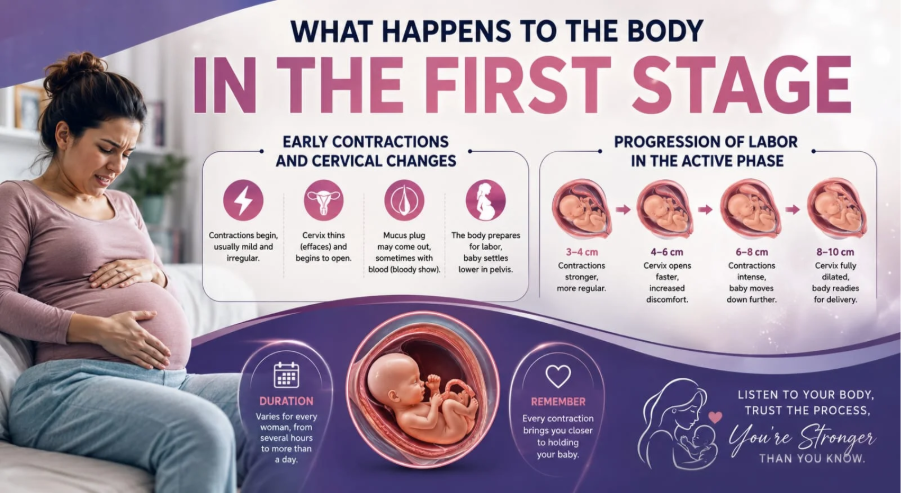
During the first stage of labor, your body slowly prepares for the birth of your baby. Regular uterine contractions cause your cervix to become soft, thin, and slowly dilate. At first, contractions may be light and irregular, but later they become stronger, longer, and more frequent.
But why does this change happen so slowly?
Everyone’s body and labor progress at a different pace. Typically, the active stage begins when your cervix is 6 centimeters dilated.
Early Contractions And Cervical Changes
Stages Of Labor In the early, the uterine muscles begin to contract regularly and the cervix gradually becomes soft, thin, and dilated. At first, contractions may be relatively light and irregular, but later they may become more regular and intense.
How do you know if the changes are truly indicative of labor progress?
Labor is usually considered to be progressing if there are consistent changes in the cervix along with regular contractions.
How Long Can The Initial Stage Take?
- There is no set time frame: The initial or latent phase can last a few hours, and in some cases, it can last several days.
- May take longer the first time: This phase is likely to be relatively long for first-time births; for many subsequent births, it may take less time.
- Contractions may come and go: At first, contractions may be irregular and may subside for a few hours before starting again—this is not always unusual.
- Time alone is not the best way to judge progress: How soft, thin, and dilated the cervix is, and how the pattern of contractions is changing—these are also important in the doctor’s or midwife’s assessment.
Progression Of Labor In The Active Phase
Stages Of Labor During the active stage of labor, labor progresses rapidly; contractions become more frequent and intense, and the cervix gradually moves toward full dilation.
How do you know if labor is truly progressing?
Regular contractions, along with the dilation of the cervix and the baby’s descent, are important signs of progress. Therefore, the mother’s feelings, the nature of the contractions, and the doctor’s assessment are the key to understanding the situation.
What Can Be Done For Comfort In The First Stage?

Breathing slowly and deeply, changing positions regularly, walking, or keeping your body in a comfortable position can be helpful in the early stages. Light pressure and massage on your partner’s waist or back can provide emotional relief.
How can you keep yourself calm when the pain increases?
Taking advantage of the time between contractions to breathe slowly, rest, and choose a comfortable method for yourself is a realistic way.
Breathing And Comfortable Position
Breathing slowly and controlled during the Stages Of Labor and choosing a comfortable position for yourself can help manage discomfort. Try to breathe deeply and slowly during contractions and walk, sit, stand, or kneel as needed.
The question is, is it best to stay in the same position for a long time?
No—it is more appropriate to change positions according to comfort and medical conditions. However, if the mother and baby need observation or treatment, the doctor’s instructions will take precedence.
The Importance Of Drinking Water, Resting And Mental Preparation
- Adequate fluid intake: If there are no complications, drinking small amounts of clear fluids during labor, as permitted by your doctor, can help reduce dehydration and fatigue.
- Make the most of the time between contractions: Resting with your eyes closed and taking slow, deep breaths during periods of pain or contractions can help calm your body and mind.
- Do not put unnecessary stress on your body: Do not stay in the same position for long periods of time, and change positions as your doctor recommends.
- Mental preparation is important: A realistic idea of the progress of labor, a trusted support person, and regular communication with your medical team can help you manage fear and anxiety.
How Does Childbirth Occur in the second stage?

In the second stage of Stages Of Labor, after the cervix is fully dilated to 10 centimeters, the baby starts to descend and the process of birth progresses with the mother’s efforts to push. After the baby’s head comes out, the shoulders and the rest of the body are gradually born.
So does this stage take the same amount of time for everyone?
No, the time may vary from person to person and the medical team decides according to the baby’s progress.
What Changes After Full Expansion?
| Stage After Complete Dilation | What Happens | What May Be Felt |
| Complete Dilation | The cervix reaches about 10 cm and the second stage begins. | Strong pressure and an urge to push may occur. |
| Baby’s Descent | The baby gradually moves downward through the birth canal. | Increasing pelvic pressure and stronger contractions. |
| Pushing Begins | Pushing generally begins once complete dilation is reached. | A strong natural urge to bear down may develop. |
| Baby’s Head Emerges | The baby’s head moves through the vaginal opening. | Intense stretching or pressure may be felt. |
| Baby’s Body Is Born | After the head is delivered, the shoulders and the rest of the body follow. | Relief often begins as the baby is completely delivered. |
What To Expect During Childbirth
During the final Stages Of Labor, when the cervix is fully dilated, the mother may feel pressure and the baby’s head slowly moves forward through the birth canal.
So, is the moment of birth the same for everyone?
No, the experience and time may vary from person to person. The doctor monitors the baby’s position, heart rate, and the mother’s progress. Supportive measures may be taken if necessary. The key to a safe birth is to follow the doctor’s instructions according to the condition of the mother and baby.
The Process Of Placenta Delivery In The Third Stage
The process of labor is not complete even after the baby is born; then the uterus contracts and helps the placenta separate from the uterine wall and pass out. At this stage, the placenta can be delivered naturally, or the process can be actively managed with oxytocin on the advice of the doctor to reduce the risk of excessive bleeding.
Why is this stage monitored so carefully?
Because complete expulsion of the placenta and good contraction of the uterus are important to prevent excessive bleeding.
How The Placenta Separates After The Baby Is Born
In the third stage of Stages Of Labor, when the uterus starts to contract again after the baby is born, the placenta gradually separates from the uterine wall and descends. Then, with gentle pressure or contractions, it comes out through the vagina.
But why does the placenta separate on its own?
The main reason is uterine contractions, which separate the placenta from the wall and help the blood vessels to contract. If necessary, oxytocin is given to speed up the process and reduce bleeding.
What Changes May Occur In The Mother’s Body During This Time?
- The uterus contracts: After the baby is born, the uterus becomes hard and starts to contract.
- Mild pain may occur: You may feel a pulling or discomfort similar to menstrual cramps.
- Some bleeding: Some bleeding is normal as the placenta comes out.
- Pressure may be felt: You may feel pressure downward as the placenta comes out.
- The uterus gradually shrinks: The uterus begins to return to its previous size through contractions.
- Monitoring bleeding is important: If there is excessive or abnormal bleeding, seek medical help immediately.
Conclusion
If you can get a detailed idea of the Stages Of Labor, you can know very precisely what kind of changes will occur in the body and what things can be expected at each stage of labor. In many cases, this reduces the mother’s fear a lot. From the beginning of labor to the birth of the baby and then the expulsion of the placenta, each stage has its own characteristics.
Knowing in advance when contractions are increasing, when the cervix is dilating, when the baby’s time to give birth is approaching – it is possible to reduce unnecessary fear and anxiety to some extent.
However, it is very important to remember that every woman’s labor experience is never the same. For some women, it may end very quickly and for others it may take much longer. Various factors, including the type of contractions, the progress of labor, the mother’s physical condition, and the baby’s position, affect this.
Knowledge and preparation reduce fear, and informed decisions make the path to safe motherhood easier.