

Learn about Infertility In Men in detail and get an idea of some of its common symptoms, causes, necessary tests related to its remedies and effective treatment methods. Following a healthy lifestyle is essential for maintaining overall male reproductive health.

Even after making a special plan to have a child, despite trying for a long time, he is not able to achieve the expected results. As a result, many people have various difficulties in their married life. Along with this, numerous questions are also created, to which we accept the prevailing superstitions or ideas in society without searching for the correct answers.
A tendency to create mental anxiety and social pressure regarding this problem is also widely observed. Many people mention the problem of women only if they do not have children, but this idea is not entirely correct and has not been scientifically established to this day.
Generally, various problems can arise in a man’s reproductive health. Such as changes in the number or quality of sperm or sometimes mental imbalance can also cause various types of physical complications.
There is a saying that is almost superstitious in people’s mouths: “If a man’s sexual ability is normal, he cannot have any difficulty in giving birth to a child.” But this idea is scientifically baseless. Sexual ability and reproductive ability can never be the same thing.
In our discussion today, we will learn about all the common factors that can affect a man’s ability to have children, as well as present various treatment methods in a very simple way.
What Is Male Infertility And Why Does It Occur?
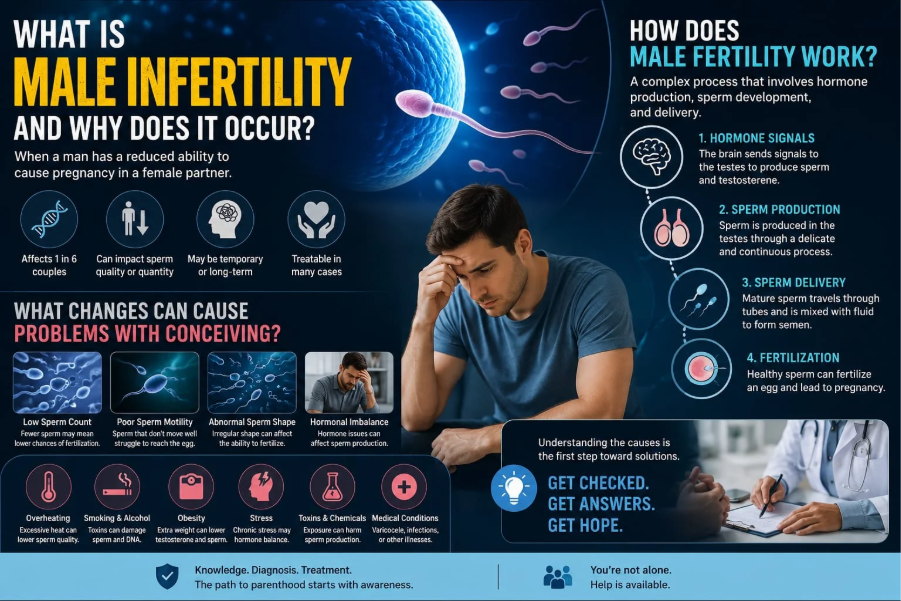
Infertility In Men refers to a special reproductive condition, where various complications and problems are seen in conceiving a child even after regular and long-term unprotected sexual intercourse.
In many cases, only women are blamed. But men also play a major role in conceiving a child. The main reason behind this may be a man’s “reduced sperm count, sperm structural problems, hormonal imbalance or some physical complications of the reproductive organs.
This particular problem may start due to excessive smoking and prolonged mental stress or exposure to excessive heat. The risk can also increase significantly.
How Does Male Fertility Work?
- Sperm production: Sperm are produced regularly in the testicles, which is one of the main foundations of male fertility.
- Sperm maturation: After being produced, sperm mature in the epididymis and gain the ability to move.
- Role of hormones: The coordination of hormones between the brain, pituitary gland, and testicles controls sperm production and the reproductive process.
- Fertilization ability: Adequate number, normal structure, and good motility of sperm are important for reaching and fertilizing the egg.
- Multiple factors work together: Therefore, it cannot be concluded that fertility is normal just because sexual ability is normal.
What Changes Can Cause Problems With Conceiving?
Infertility in men can be specifically related to various physical and reproductive changes. Some common problems include: decreased sperm count, various structural complications, hormonal imbalances, etc.
| Change | Possible Impact |
| Low Sperm Count | Fewer sperm available for fertilization |
| Poor Sperm Motility | Difficulty reaching the egg |
| Abnormal Sperm Shape | May reduce fertilization ability |
| Hormonal Imbalance | Can affect sperm production |
| Blocked Reproductive Tract | May prevent sperm from reaching semen |
What Lifestyle Habits Increase The Risk Of Miscarriage?

In daily life, men can suffer from some bad habits that can negatively affect their reproductive health.
Those who smoke excessively, consume excessive alcohol or drugs regularly, or are overweight are also deeply related to decreased reproductive capacity. Excessive smoking can have a serious impact on sperm concentration and structure. Excessive alcohol or drug use can accelerate sperm quality and normal levels of testosterone hormones.
Furthermore, using anabolic steroids may suppress the body’s natural sperm production. However, medical evaluation is required in each case to determine the cause.
How Do Smoking And Alcohol Affect Fertility?
Smoking and excessive alcohol consumption play a very effective role in increasing the risk of infertility in men. They can directly and indirectly cause more complex problems in humans and the human reproductive system.
- Smoking: Can negatively impact sperm count, motility, and structure.
- Excessive alcohol: Can affect testosterone and sperm production in the long term.
- Sperm quality: Both habits can negatively impact fertility in some men.
- Practical steps: Quitting smoking and avoiding alcohol are beneficial for reproductive health.
Can Excess Weight And Obesity Reduce Sperm Quality?
Excess weight gain causes various complications. It can have an unfavorable impact on the reproductive health of men. Excess body weight can significantly affect sperm concentration and motility, causing them to fall below normal levels. The accumulation of excess body fat may disturb the normal balance of hormones in the body. As a result, the body’s sperm production is hampered.
What Are The Common Causes Of Male Infertility?
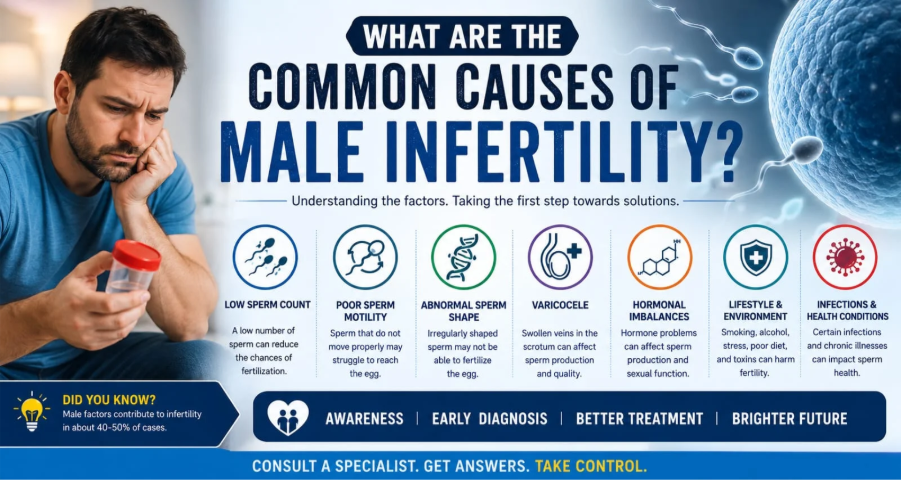
The problem of Infertility In Men occurs due to various physical, hormonal and reproductive problems. Structural abnormalities in sperm and significantly reduced sperm numbers may also be contributing factors. In addition, various complications and obstacles can arise due to hormonal imbalance in the path of sperm movement. In addition, the symptoms of these problems can appear due to some infections and genetic reasons.
- Genetic problems — Some genetic changes can affect sperm production.
- Sperm problems — There may be abnormalities in the number, motility, or structure.
- Hormonal imbalances — A lack of essential hormones can reduce sperm production.
- Testicular problems — Some diseases or damage to the testicles can affect fertility.
- Obstruction in the reproductive tract — If sperm are produced but there is a blockage in the path of ejaculation, problems can occur.
- Infections — Some infections can affect the reproductive organs or sperm function.
How Is Male Infertility Diagnosed?
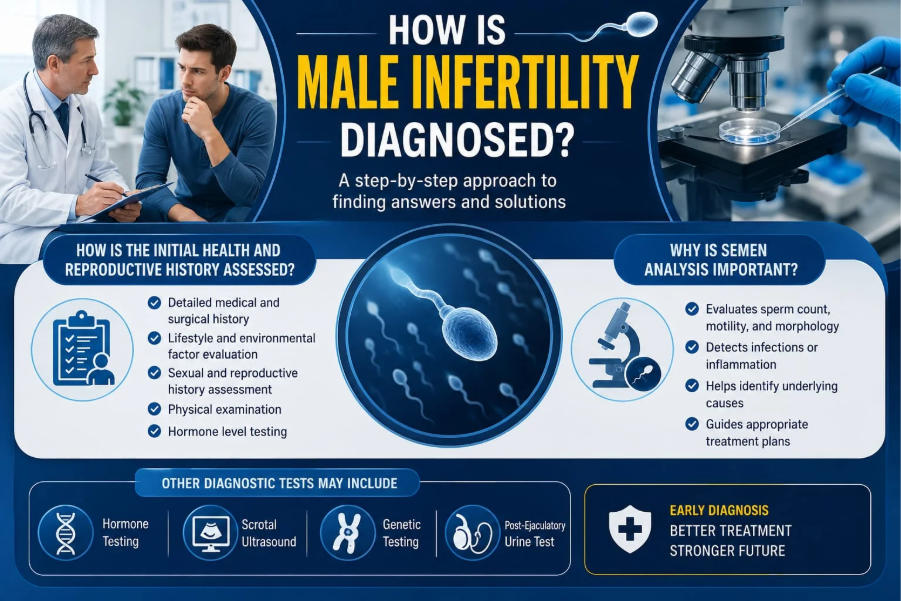
Modern medical technology is playing a very effective role in diagnosing male infertility. To diagnose male infertility, the doctor first knows about the patient’s health, sexual and reproductive history and searches for important information about whether he has received any previous diseases or treatments.
Semen analysis is commonly performed to examine key sperm characteristics, including count, motility, and structure. Then, according to the need for treatment, hormone tests and ultrasound or genetic tests may be required using various advanced technologies.
However, we must keep in mind that it is never possible to make a final decision with the results of a single test.
How Is The Initial Health And Reproductive History Assessed?
Infertility In Men At the beginning of the evaluation of the problem, the doctor can learn about the person’s overall health, previous diseases, surgeries, medication use, and sexual and reproductive history.
Usually, doctors evaluate these types of questions first. For example, the doctor must be informed about how long you have been trying to conceive, how your sexual relationship is going, whether you have any sperm problems or previous reproductive complications.
In addition, a physical examination of the man’s testicles and reproductive organs may also be necessary. After evaluating all this information, the doctor can make a decision.
Why Is Semen Analysis Important?
- Sperm count: This evaluates the number of sperm found in a given quantity of semen.
- Structure: This also checks whether the shape and structure of the sperm are normal.
- Semen characteristics: This gives an idea of the volume, pH, and other important characteristics of the semen.
- Problem identification: This is an important initial test to identify potential problems with sperm production or quality.
- Result confirmation: The results of a test are not always conclusive; if necessary, the test may be repeated with the advice of a doctor.
When Might Additional Hormone And Other Tests Be Needed?
| When It May Be Considered | Possible Test | What It Can Help Assess |
| Low sperm count | Hormone tests | Testosterone and reproductive hormone levels |
| Very low or absent sperm | Genetic testing | Possible genetic causes |
| Suspected blockage | Scrotal ultrasound | Structural problems or abnormalities |
| Abnormal physical findings | Specialized imaging | Reproductive tract conditions |
| Persistent unexplained problems | Further fertility tests | Additional possible causes |
What Are The Treatment Options?

Treatment for Infertility In Men depends on the specific cause of the problem, health conditions, and fertility test results. Depending on the underlying issue, doctors may recommend medications, hormone therapy, or surgery as appropriate.
In selected cases, assisted reproductive procedures such as IUI and IVF may offer another option using sperm. In addition, quitting smoking, maintaining a healthy weight, and avoiding harmful habits may also be important parts of treatment.
How Is Treatment Determined According To The Cause?
- If there is a problem with sperm: Further treatment is determined based on the results of the sperm count, motility, and structure.
- Hormonal problems: If there is a specific hormone deficiency, treatment may be given according to the cause.
- Obstruction in the reproductive tract: Surgery may be required depending on the location and cause of the obstruction.
- If there is a varicocele: The doctor may consider surgery in suitable patients.
- Drug or lifestyle effects: Harmful drugs, steroids, or some habits may need to be corrected.
When Might Medication And Surgery Be Necessary?
Infertility In Men, medication or surgery is not necessary for everyone. Appropriate medication can be used for specific hormonal problems.
Again, if there are some structural problems like varicocele or obstruction in the reproductive tract, surgery is considered in selected patients. Before deciding on treatment, the results of Semen Analysis, physical examination and other necessary tests are usually evaluated together.
When Are Assisted Reproductive Techniques Considered?
- If the sperm count is very low: If the chances of fertilization naturally are low, IUI, IVF or ICSI may be considered.
- If the sperm motility is severely low: If there is a problem reaching the egg, assisted reproductive technology may be necessary.
- If there is a blockage in the fallopian tubes: If surgical treatment is not possible or appropriate, ART may be considered.
- If pregnancy does not occur despite repeated treatments: The doctor may recommend ART after a comprehensive assessment of the couple.
- If ICSI is needed: If very few sperm are found, a method of directly injecting a selected sperm into the egg can be used.
- Treatment varies from person to person: The appropriate method is selected based on the results of the semen analysis, age, reproductive health of both partners and previous treatment.
What Are The Common Misconceptions?

- ❌ Not having children is only because of women — wrong. The reproductive health of men can also influence the chances of conception.
- ❌ Normal sexual ability means normal fertility — wrong. Sexual ability and sperm quality are two different things.
- ❌ If the semen is high, the sperm is good — wrong. Healthy sperm count, proper movement, and normal structure are also important.
- ❌ Once the Semen Analysis is normal, everything is fine — not always. The results may need to be re-evaluated depending on the situation.
- ❌ There is no change in male fertility with age — wrong. Some reproductive changes may occur with age.
- ❌ Infertility means the inability to have children — wrong. Depending on the cause, the opportunity for pregnancy can be created in many cases through treatment and assisted reproductive methods.
Conclusion
Infertility in Men is a significant reproductive health problem, but it does not mean that the possibility of conceiving a child is over. Problems with sperm count or motility, hormonal imbalance, testicular complications, obstruction of the reproductive tract, genetic factors and some lifestyle habits can play a role in it. Smoking, excessive alcohol consumption, obesity and exposure to some harmful substances can also have a negative impact on reproductive health.
Usually, along with evaluating health and reproductive history, Semen Analysis is done and hormonal, genetic or other tests may be done as needed. After determining the cause, treatment also varies from person to person. In some cases, lifestyle changes, medication or hormone treatment may be sufficient; on the other hand, surgery may be required for certain structural problems.