
Baby Sleep Routine By Age From Newborn To 12 Months 

Nusrat Ayaan

Published: 25/07/2026
Updated: 25/07/2026

Get detailed knowledge about the sleep schedule, naps, night sleep and effective guidelines for building healthy sleep habits for babies from newborn to 12 months according to Baby Sleep Routine. 

“Why does my little one wake up repeatedly at night?” 

This question comes to the mind of almost all new parents at some point and it is normal to come. From newborn to one year of age, the sleep schedule of babies changes very rapidly. For a few months after birth, they sleep and wake up again after very short periods of time. Then gradually babies fall asleep at a specific time during the day and develop the habit of sleeping for a long time at night. 

These changes are very normal, but if the schedule is not right, the restlessness and excessive crying of the baby can increase to an excessive extent. 

Therefore, we should understand the sleep needs of each baby according to their age. Because if we do not understand this gap, various types of complex problems can arise. The sleep needs of a one-month-old baby and the sleep needs of a 9-month-old baby can never be the same. 

Feeding at a specific time, as well as putting them to sleep at a specific time, and explaining the difference between light and darkness to the newborn baby should be done. A baby needs to be provided with a comfortable sleeping environment so that the baby can sleep comfortably. 

In this article, we will discuss the normal stages of sleep for a baby from birth to one year, the number of naps during the day, and practical and easy ways to develop healthy habits of sleeping at a specific time at night. 

How Sleep Changes In The First Year After Birth 

Following the Baby Sleep Routine shows that the baby’s sleep pattern changes gradually in the first year of life. In the first three months of life, babies sleep for 14 to 17 hours day and night, but their sleep is often interrupted for feeding. 

From four to six months of age, the body’s organic growth begins to develop gradually, and signs of sleeping longer at night are seen. 

Most babies sleep twice a day at 7 to 12 months of age, and the habit of sleeping relatively longer at night is seen to develop. It is normal for sleep habits to change gradually with age. However, we should always develop the habit of going to bed according to the rules. 

Normal Sleep Patterns In The First Trimester 

Age Total Sleep (in 24 hours) Daytime Nap Night Sleep General Features 
0–4 Weeks 14–17 Hours 4–6 Times Popper wakes up in 2–4 hours Wakes up frequently due to hunger, does not understand the difference between day and night 
1–2 Months 14–16 Hours 4–5 Times Some babies can sleep for 4–6 hours straight. Waking time gradually increases. 
2–3 Months 13–15 Hours 3–4 Times Relatively long sleep may begin Restlessness may occur in the evening, starting to respond to regular routines 

However, we must remember that every baby’s sleep needs are different. The above schedule may be more or less, and the baby’s hunger and normal behavior are the most important factors in this regard. 

Developing New Habits In Four To Six Months 

If we follow the Baby Sleep Routine regularly, we will understand that babies’ sleep gradually starts to become regular at the age of four to six months. At this time, the baby can sleep continuously for a long time, up to 6 to 8 hours at night. Also, if the baby’s parents can create a calm environment, then it will be much easier to develop new sleep habits. 

Important Changes 

  • Total sleep: about 13–15 hours 
  • Daytime naps: 3–4 times 
  • Nighttime sleep: can be as long as 6–8 hours 
  • Effect of routine: A regular bedtime helps establish a baby’s biological clock 

Sleep Stability Increases From Seven To Twelve Months 

  • 💤 Total Sleep Time: Most babies sleep about 12–14 hours during the day and night. 
  • 🌙 Nighttime Sleep Is Longer: Many babies can sleep for up to 10–12 hours relatively soundly, although it is normal to wake up for short periods of time. 
  • ☀ ️ Daytime Naps Decrease: A habit of taking two naps is usually formed. 
  • ⏰ Regular Schedule Is Important: The habit of going to bed and waking up at the same time every day helps stabilize the body’s biological clock. 
  • 🦷 Teething Effects: Teething, learning new skills, or separation anxiety can temporarily cause more waking during the night. 

How Many Times And How Long Is It Normal To Nap During The Day? 
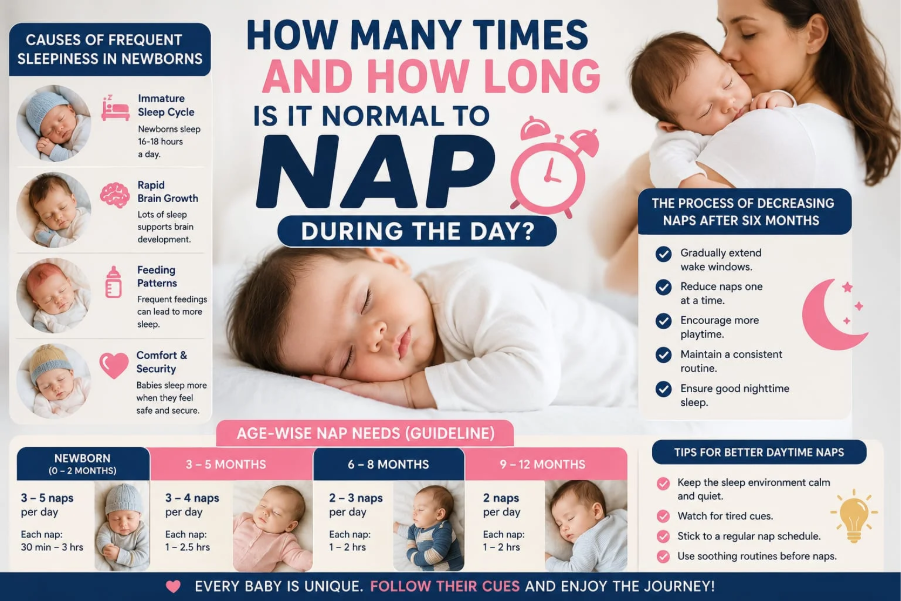
According to Baby Sleep Routine, the number and duration of baby sleeps throughout the day varies with the age of the baby. Newborn babies usually sleep six times a day and can sleep from 30 minutes to 2 hours each time. 

A baby aged four to six months sleeps three to four times a day and a baby aged 7 to 12 months mostly sleeps twice a day. 

So if a newborn baby sleeps less during the day, the baby may suffer from restlessness, and sleeping for an excessively long time may reduce the amount of sleep at night. 

Causes Of Frequent Sleepiness In Newborns 

By following the Baby Sleep Routine, we will understand that newborns can sleep for about 14 to 17 hours during the day and night. Since their brain and body are in a stage of rapid development, it is completely normal for them to sleep for short periods of time. During this time, it is more important to save energy by sleeping repeatedly than for long periods of sleep. 

Common causes of sleep deprivation: 

  • Feeling hungry 
  • Wetting diapers or discomfort 
  • Feeling too hot or cold 
  • Feeling the need to be held 
  • Startled by sudden noises or lights 
  • Stomach discomfort or gas 

The Process Of Decreasing Naps After Six Months 

  • 🌙 Nighttime sleep begins to lengthen, resulting in a gradual decrease in the need for daytime sleep. 
  • ☀️ Many children go from 3–4 naps a day to 2–3. 
  • ⏰ Waking time increases, usually up to 2–3 hours. 
  • 💤 Morning and afternoon naps become more important, with short evening naps often being skipped. 
  • 📅 The change is gradual, not sudden—nap time may decrease or be completely eliminated over a period of weeks. 
  • 😴 If a child is tired or overly irritable after skipping naps, they may still feel the need for their previous routine. 
  • 🛏️ Regular naps help stabilize the body’s biological clock and can improve nighttime sleep. 

Effective Ways To Help You Sleep Longer At Night 

By following the Baby Sleep Routine, we will know that some small good habits of parents help a child sleep longer at night. Such as putting him to bed at the same time every day, not taking too long naps during the day and the most important thing is “creating a calm environment before sleeping”

The baby’s body is prepared for sleep by using dim lighting, low noise and regular bathing. Also, after feeding the baby at night, it is necessary to quickly create a sleep environment again without excessive play. This gives the best results. 

The Importance Of Going To Bed At A Specific Time 

By gaining knowledge about Baby Sleep Routine, we will understand that putting a child to sleep at a specific time every day can play an important role in shaping his biological clock. At the same time, if the habit of sleeping at the same time is formed, the body itself understands when it is time to rest, that is, when to sleep, and the possibility of sleeping for a long time at night increases. 

Irregular sleep makes children feel extra tired and tends to wake up repeatedly at night. A child will be taken care of by his parents according to the daily routine, which makes the task of taking care of him much easier. 

Find out more here: Crystals for Birth and Labor

Maintaining A Balance Between Eating And Sleeping 

Situation What To Do Why Is It Important 
After Waking Up Feed First The child stays refreshed and can eat well. 
Immediately After Feeding Keep It Calmly On Your Lap For 10–20 Minutes Helps relieve belching and discomfort 
Before Sleep Create A Quiet Environment By Dimming The Lights The body prepares for sleep. 
Before The Daytime Nap Feed If There Are Signs Of Hunger Reduced waking due to hunger 
At Night Eat Calmly Without Excessive Exercise The child can fall back asleep quickly. 
If You Fall Asleep While Eating, Slowly Lay Down On The Bed Helps to develop normal sleep habits 

What Signs Indicate That The Schedule Needs To Be Changed? 

By following the Baby Sleep Routine, we can get an idea of several things that can be changed. If the baby’s current schedule does not match his needs, then some clear signs may appear. 

For example, the baby takes a long time to sleep, is restless most of the day, sleeps very little during short naps. Also, waking up repeatedly at night, these things should not be neglected at all. 

As soon as these signs appear, the baby’s daily routine must be changed. At the same time, excessive crying or waking up tired indicates that the balance between sleep and wakefulness is not right. 

However, no changes should be made suddenly, making changes gradually is the safest and most effective method. 

Excessive Crying Or Restlessness 

  • Crying for a long time every day at a certain time may be a sign of excessive fatigue or an irregular sleep schedule. 
  • Repeated crying or fidgeting during sleep may be a sign of discomfort or over-awakeness in the baby. 
  • Sleeping later than usual is often due to excessive excitement or fatigue. 
  • If the baby wakes up after sleeping for a very short time and starts crying again, it is necessary to monitor whether the daytime nap is sufficient. 
  • If the baby wakes up repeatedly at night and cries, it may be beneficial to reconsider the evening routine and bedtime. 
  • If the baby has a sudden major change in behavior, fever, reluctance to eat, or unusual crying, a pediatrician should be consulted. 

The Most Common Mistakes New Parents Make 

According to Baby Sleep Routine, new parents often make some common mistakes with their children. For example, keeping the baby awake until he is overly tired or trying to put him to sleep after every cry. Most new parents do not put the baby to sleep at a specific time, that is, they do not follow the schedule. 

In many cases, the habit of putting a baby to sleep late at night increases the restlessness of the child’s brain. On the contrary, if the child actually falls asleep, some common symptoms will appear. 

Such as rubbing the eyes, yawning or decreased attention. If you notice these things, putting him to sleep according to that time will be most effective. Along with this, you need to create a fixed routine. 

Having Extra Stimulating Activities During The Day 

  • Keeping the child with music, TV or videos playing too loudly for a long time 
  • Having too many guests, traveling or introducing them to new environments in a day 
  • Excessive play, jumping or physically stimulating activities close to bedtime 
  • Looking at a brightly lit mobile, tab or screen for a long time (especially before evening) 

Conclusion 

Baby Sleep Routine is deeply related to the healthy growth of the baby, brain development and the daily comfort of the family. Sleep patterns change rapidly in the first year after birth, so the most effective way is to gradually create a regular schedule based on age-based needs. Putting the baby to bed at a specific time, balancing daytime naps, creating a calm environment and noticing the baby’s signs of tiredness – these small habits lay the foundation for good sleep in the long run. 

Patience, regularity and love – these three things are the biggest keys to a baby’s healthy sleep. 

There is a proverb about this regular sleep routine for children – 

“A baby’s peaceful sleep means a peaceful night for the family.” 

         “Today’s regular habits are the foundation for a healthy life tomorrow.” 

Related Articles

Newborn Baby Care

Newborn Baby Care Guide To Build Healthy Daily Habits 

This article will give some very nice tips about easy and practical ways to do Newborn Baby Care. By following which, you can develop healthy habits in the health, cleanliness and safe daily care of the newborn. 

How many times a day should a newborn baby be fed? Or how to create a safe sleeping environment for a newborn baby? 

Those who have already become new parents are quite worried about the above issues. From this worry, numerous questions naturally start to think about them. Those who have become new parents want to understand the needs of the little baby and create a reliable routine of proper daily care but cannot find the right information anywhere. 

You will be happy to hear that this article has been arranged with easy and effective solutions to this problem. 

New parents often make some simple small mistakes without knowing it. Most parents choose the same reason every time as the reason for the baby to cry. On the other hand, there are many who do not give much importance to the issue of sleep safety. 

There are also people who over-cleanse their babies, causing problems for their sensitive skin. 

Table Of Contents 

What Habits Are Most Important When Feeding A Newborn? 

The healthy growth of a newborn depends on the correct habits and rules of Newborn Baby Care. Especially, proper eating habits play a very effective role in this regard. 

A newborn baby shows various signals like taking hands to mouth or becoming restless when he is hungry. We should understand all these signs and breastfeed the newborn on time, latch on properly. Along with this, helping a newborn baby to look after itself after feeding is also a very important task. 

It is a good habit to give the most importance to his natural needs rather than force-feeding a baby. 

How Often And How Should A Baby Be Fed? 

  • Watch for hunger cues: It is better to feed your baby based on his/her signs of hunger—looking for his/her mouth, putting his/her hand to his/her mouth, or being restless—than by the clock. 
  • Regular feeding: A breastfed newborn can usually feed about 8-12 times in 24 hours. However, not every baby has the same needs. 
  • Latch correctly: It is important to insert not only the nipple but also some parts around it into the baby’s mouth well. This makes milk intake easier and reduces mother’s discomfort. 
  • Feed at the baby’s pace: There is no need to force feed again if the baby lets go or signals satisfaction. 
  • Burping after feeding: If necessary, hold the baby upright and gently pat the back to help him/her burp. 

How Do You Understand The Signs Of Getting Enough Milk? 

To do Newborn Baby Care, I have to pay special attention to several things. One of them is to ensure that the baby has enough milk. This can be confirmed by looking at several signs. 

For example, if the baby is calm and satisfied after feeding, urinates regularly, and gradually gains weight. If these things occur, it should be assumed that the baby is getting enough milk. In some cases, the baby’s face and skin may also show signs of looking naturally fresh. 

It is not right to make decisions based only on the amount of crying or the softness of the breasts. If the weight does not increase or the urine output decreases abnormally, it is important to consult a doctor. 

What Common Mistakes Should You Avoid When Feeding? 

Common Mistake Why Avoid It? Better Approach 
Feeding on a strict clock only Baby’s hunger needs may vary Watch hunger cues 
Poor latch May reduce effective milk transfer Ensure a deep, comfortable latch 
Forcing the baby to finish Can ignore fullness cues Let the baby stop naturally 
Skipping feeds regularly May affect milk intake Feed frequently as needed 
Ignoring feeding difficulties May delay help when needed Seek professional guidance if concerns persist 

How To Keep A Baby’s Sleeping Environment Safe And Comfortable? 

An important and special part of Newborn Baby Care is creating a safe sleeping environment for a newborn baby. 

A baby should always be placed on a firm and flat bed. Pillows, heavy blankets or soft toys or loose clothes should be avoided in the bed. It is best to keep the room temperature at a tolerable level at all times, it is not advisable to create an environment that is excessively cold or excessively hot. 

A newborn baby’s sleeping place should be kept close to the parents. Along with this, the bed should be cleaned regularly. It should be kept away from any smoke and odorous substances. 

What Things Should Not Be Kept In The Sleeping Area? 

  • Pillows: Pillows should not be placed under a newborn’s head. A flat, firm sleeping surface is safest. 
  • Soft toys: Do not place teddy bears or other soft toys in the baby’s sleeping area. 
  • Loose blankets and sheets: These can cover the baby’s face. Use appropriately fitted sleepwear if necessary. 
  • Bumpers or soft bedding: There is no need to place soft bumpers or extra padding around the crib. 
  • Bottles or feeding items: Bottles should not be placed next to the baby during sleep. 
  • Extra warming materials: Avoid using hot water bags, electric blankets, or extra heavy blankets. 

What Is The Role Of Parents In Creating A Baby’s Sleep Routine? 

As an important part of Newborn Baby Care, parents should maintain patience and consistency in sleep routine. By turning on the dream light every night, creating a sleep environment according to a calm and set temperature, and following some similar simple habits, the baby gradually learns to understand sleep times. 

Discover more here: Causes Of Miscarriage

How To Clean And Care For A Newborn’s Navel? 

Maintaining cleanliness is also a very important aspect of Newborn Baby Care. In addition to keeping the environment around a newborn baby and the baby’s body clean, extra precautions should be taken in caring for the umbilical cord. 

Before touching a newborn’s umbilical cord, you must wash your hands thoroughly with soap and water and clean the area around the umbilical cord and keep the umbilical cord and the area around the umbilical cord dry. 

Using oil, powder, or any household items on the umbilical cord can be harmful. And while putting on a diaper, it should be done in such a way that it is below the umbilical cord. If the umbilical cord is red, swollen, or has a foul-smelling discharge, consult a doctor immediately. 

What Should You Know About Keeping The Navel Area Clean And Dry? 

  • Do not apply any substances: Avoid using oil, powder, ash, turmeric or any household substances on the navel. 
  • Allow for ventilation: Do not wear tight clothing over the navel, but use loose and clean clothing. 
  • Fold the diaper down: Place the front of the diaper below the navel, so that there is no friction or wetness at the base of the navel. 
  • Do not pull on your own: Do not try to pull or tear the remaining part of the navel, even if it is dry; let it fall off naturally. 
  • Watch for unusual symptoms: Seek medical advice immediately if there is redness, swelling, pus or foul-smelling fluid around the navel, or a fever. 

How To Keep Hands And Baby Items Clean? 

Item How to Keep It Clean Important Tip 
Baby’s Hands Gently clean with clean water when needed Keep nails short and clean 
Parents’ Hands Wash with soap and water before touching the baby Especially before feeding 
Feeding Bottles Wash thoroughly after every use Follow proper sterilization guidance 
Pacifiers Clean and sterilize regularly Never clean by putting it in your own mouth 
Towels & Clothes Wash regularly and dry completely Keep them separate and clean 

What Should Parents Know About Baby Skin Care And Bathing? 

In the case of Newborn Baby Care, we should always keep in mind that a newborn’s skin is very soft and sensitive. So we should take extra precautions in this regard. 

Especially when bathing a newborn, lukewarm water should be used. Also, it is better to finish bathing quickly. Gently Clean The Skin With A Mild, Fragrance-Free Cleanser When Needed. After bathing, the water should be gently dried with a soft towel. Try to keep the newborn’s skin folds as dry as possible. 

If the skin is dry, a baby-friendly moisturizer can be used. 

What Gentle Approaches Can Help Care For Sensitive Skin? 

Newborn Baby Care should be as simple and gentle as possible for sensitive skin. Fragrance-free and gentle products can be used before bathing, and the skin should be gently dried with a soft cloth after bathing. 

  • Use gentle products: Avoid products with fragrances and alcohol. 
  • Keep baths short: Do not soak in water for long periods of time. 
  • Handle The Skin Gently: Avoid rubbing and pat it dry with a soft towel. 
  • Wear soft clothing: Choose clean and airy clothing. 
  • Avoid unnecessary products: Consult a specialist before using oils, powders or household ingredients. 
  • Watch for skin changes: Consult a doctor if a rash, sores or unusual redness persists. 

What Should You Do When Your Skin Becomes Red Or Irritated? 

If redness or irritation appears on the skin, the first thing to do is to find out the cause of this rash. This irritation can be caused by various reasons, such as using a new cosmetic, rubbing the skin too much to dry it after bathing, etc. If these problems are noticed, then you should definitely stop using those things. 

If the rash spreads quickly, blisters, pus comes out, or the child has a fever, it is important to consult a doctor without delay. 

What Mistakes Do First-Time Parents Commonly Make In Childcare? 

Those who are new to Newborn Baby Care tend to make some common mistakes due to excessive caution or various misconceptions prevalent in the society. 

Such as dressing the newborn baby with extra clothes, keeping pillows or other soft things in the baby’s sleeping place, feeding the baby at a specific time without understanding the baby’s wetness signals. Along with using different types of oils and home remedies on the navel. Usually these things can be observed significantly. 

Again, it is not right to use unnecessary products just because of a slight rash or crying. If in doubt, it is safe to seek medical advice. 

What Is The Problem With Overdressing Or Covering A Child? 

  • Risk of overheating: Wearing too many clothes can increase a baby’s body temperature. 
  • Discomfort and sweating: If your baby is sweating excessively on their neck, chest, or back, you may need to reduce their clothing. 
  • Choose light clothing: Wear comfortable, soft, and breathable clothing according to the weather. 
  • Check the neck or chest: There is no need to add extra clothing if your hands and feet feel cold; try to feel your baby’s neck or chest to see if they are overheated. 
  • Watch out for unusual symptoms: Seek medical attention immediately if you notice excessive sweating, very hot skin, rapid breathing, or unusual lethargy. 

Conclusion 

The main goal of Newborn Baby Care is to create a safe, clean and comfortable environment for the newborn, where his normal growth and development are not hindered. It is very important to feed the baby by understanding his hunger signals, observing whether he is getting enough milk, and maintaining proper habits while feeding. Similarly, it is important to arrange safe sleep, remove pillows and soft objects from the sleeping area, and not cover the baby with excess clothes. 

Keeping the umbilical cord clean and dry, taking gentle care of the baby’s skin, and not using various cosmetics or household items unnecessarily are also part of the newborn’s protection. The biggest responsibility of new parents is to understand the baby’s natural signals and respond patiently. Remember, regular small safe habits create a strong foundation for the baby’s well-being rather than any big event in newborn care. 

Scroll to Top