

Learn about the common beliefs and real explanations of scientific data related to the topic of Gender Prediction Myths in our article today. So that you can understand the correct information about pregnancy very easily.

One of the natural questions that comes to mind among all of us is: Is it ever possible to say for sure whether the baby is a boy or a girl by looking at the mother’s physical symptoms during pregnancy?
No!! According to modern medical science, there is no such symptom or home method that can be said to be 100% sure whether the baby will be a boy or a girl.
This curious question has been spread by various common beliefs, family ideas and folk methods for many years. Therefore, various kinds of curiosity arise in every family about this issue. There are many families among us who guess by looking at the shape of the mother’s belly, while some consider the taste of food or changes in the skin as an indication of whether the baby is a boy or a girl. This is a very important issue regarding this issue.
Through various advanced treatments in modern medical science, it has been found that determining the sex of a child is a completely biological and genetic process. Therefore, it is never possible to understand it accurately by looking at external changes. Yet, there are many among us who are confused by misinformation and rumors, and who create unnecessary and high expectations. Therefore, we should make the right decisions based on scientific theories.
Why Is There So Much Curiosity About This Topic?
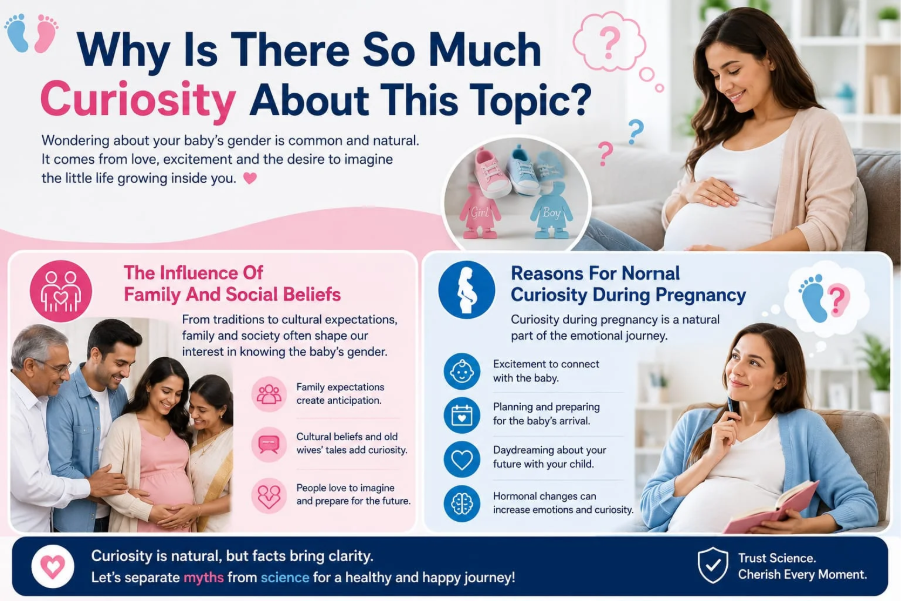
Gender Prediction Myths The main reason for thinking about the subject in advance is the curiosity to know the child naturally and the various beliefs prevalent in our society for generations. These things naturally make people interested in knowing the gender of the child in advance.
You will be surprised to know that even in today’s society, people consider fabricated information related to relatives and various social superstitions as true, even though each of them is almost meaningless and has no scientific basis. These false mistakes that fall on social media or spread by word of mouth only increase people’s curiosity.
Therefore, it is necessary to gain knowledge about the reality about factual information and scientific explanations.
The Influence Of Family And Social Beliefs
| Traditional Family Or Social Beliefs | Realistic Effects |
| Considering the experience of elders as the ultimate truth | Misconceptions can persist for a long time without scientific evidence. |
| Relying on the personal experience of relatives | One person’s experience does not apply to everyone. |
| Guessing by looking at the shape of the stomach, taste of food, or external changes | There is no reliable scientific relationship between these symptoms and the baby’s gender. |
| Being quick to believe information from social media and word of mouth | Misinformation spreads quickly and causes confusion among people. |
| Creating expectations in advance based on conventional wisdom | If expectations are not met, mental depression or family stress may arise. |
Reasons For Normal Curiosity During Pregnancy
Gender Prediction Myths are a topic that fascinates and intrigues people. The main reason for this is the natural emotions and thoughts about the future of the unborn child. People believe these popular ideas out of curiosity about the future child. And these popular ideas have gained the most popularity because of this belief.
- Curiosity about the baby during pregnancy is completely normal.
- The interest of family and relatives further increases this curiosity.
- Popular ideas easily become people’s beliefs.
- Misconceptions can persist for a long time due to the lack of scientific information.
- Reliable medical information helps reduce confusion.
The Scientific Reality Of Popular Ideas
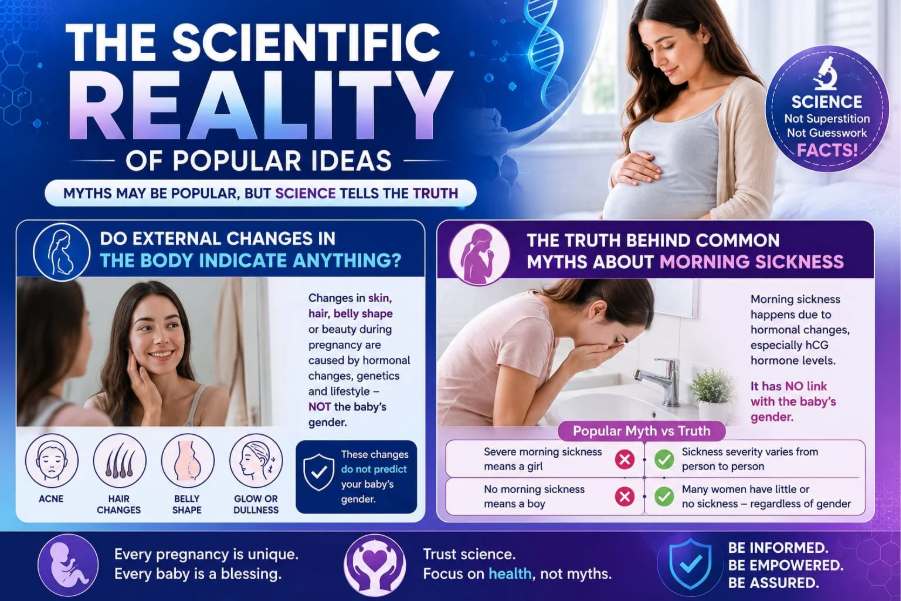
Although many common ideas about Gender Prediction Myths have been spread for a long time, most of them have been proven to be wrong by modern medical science. Determining the sex of a child is usually a biological and complex process. It cannot be clarified through symptoms or external changes.
A child’s biological characteristics are determined when it is fertilized. Therefore, it cannot be determined by looking at the shape of the mother’s belly. During pregnancy, various changes in the mother’s skin, including her taste in food, can be clearly observed. The sex of the baby can never be clearly determined by looking at these changes.
Real data and scientific research are considered the most reliable basis for this.
Do External Changes In The Body Indicate Anything?
While it’s perfectly normal to experience a variety of body changes during pregnancy, they’re not reliably linked to gender determination. Pregnancy involves hormonal changes and some physical changes, so it’s simply foolish to assume the sex of your unborn baby based on these.
Does this really indicate anything?
- ❌ The gender of the baby cannot be determined by looking at the shape of the abdomen.
- ❌ Skin brightness or dullness is not a reliable sign.
- ❌ There is no scientific relationship between facial beauty or acne and the gender of the baby.
- ❌ External changes in the body are mainly the result of hormones, weight gain, and physical adaptation.
- ✅ Only the results of medically recognized tests are reliable for knowing the gender of the baby for sure.
The Truth Behind Common Myths About Morning Sickness
According to Gender Prediction Myths, there are many adults among us who believe that if you have morning sickness or any other time of the day, you are more likely to have a girl. This idea is not entirely correct. According to medical science, severe nausea can be caused by hormonal changes and various complex physical processes.
| Popular Belief | Scientific Reality |
| Excessive Nausea Means A Girl | There is no reliable scientific evidence for this claim. |
| Less Nausea Means A Boy | The degree of nausea does not determine the sex of the baby. |
| Everyone Experiences The Same Type Of Nausea During Pregnancy | Each woman’s physical reaction may be different. |
| The Cause Of Nausea Is The Gender Of The Baby | In fact, hormonal changes and body adaptation are the main reasons. |
The Truth And Lies Of The Most Popular Beliefs
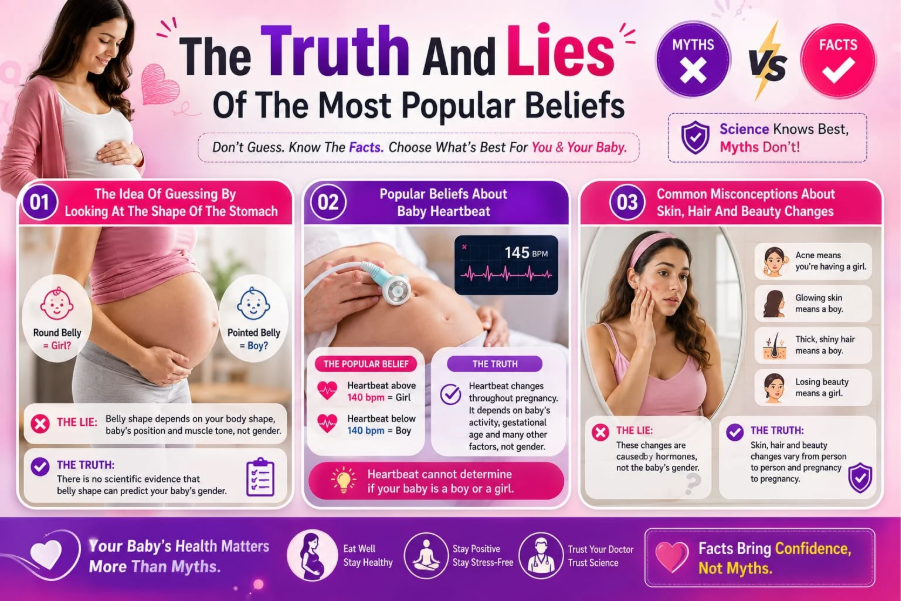
There have been many superstitions in society regarding Gender Prediction Myths for many years. Many people believe that if a pregnant mother’s stomach is facing forward, she will have a boy, if she wants to eat more sweets, she will have a girl, if she has more morning sickness, she is more likely to have a girl, if the baby’s heartbeat is fast, it will be a girl, or if the mother’s beauty is less beautiful, she will have a girl.
Although these ideas are common in family experience and folk tales, none of them have reliable scientific evidence in modern medicine. In reality, the sex of the child is genetically determined at the moment of fertilization. Therefore, it is most reasonable to rely on scientific data instead of making any decisions based on external signs or conventional beliefs.
Discover more here: Maternal Mental Health
The Idea Of Guessing By Looking At The Shape Of The Stomach
A misconception that has been prevalent in our society for many years is: “Many people first guess whether the baby will be a boy or a girl by looking at the shape of the mother’s belly during pregnancy.”
Many people think that if the mother’s belly is high in the front, the baby will be a boy, and if it is wide or spread to the sides, the baby will be a girl.
However, according to modern medical science, the shape of the belly mainly depends on the mother’s physical structure and muscles. It also depends on the position of the baby in the womb or the amount of amniotic fluid.
Therefore, determining whether a baby will be a boy or a girl by looking at the shape of the mother’s belly is a completely wrong idea that has no scientific basis.
Popular Beliefs About Baby Heartbeat
Gender Prediction Myths A long-standing superstition is that many people predict whether a baby will be a boy or a girl by looking at the baby’s heartbeat. However, as medical science shows, the heart rate can vary depending on the age of the fetus, the baby’s movements, and other physiological changes.
Common misconceptions about baby’s heartbeat:
- If it is more than 140 beats/minute, it will be a girl.
- If it is less than 140 beats/minute, it will be a boy.
- The gender can be estimated by looking at the heart rate on the first ultrasound.
- The heart rate is always at the same level, so it is a sure indication.
- The difference in heart rate is due to the sex of the baby.
[Reality: Modern research has proven that it is never possible to reliably predict whether a baby will be born a boy or a girl based on the baby’s heart rate during pregnancy.]
Common Misconceptions About Skin, Hair And Beauty Changes
| Popular Belief | Scientific Reality |
| If the mother’s beauty decreases, the child will be a girl. | There is no reliable scientific evidence to support this claim. |
| If you have more acne on your face, you are more likely to have a girl. | Acne is usually caused by hormonal changes, not by the baby’s gender. |
| If the skin is fair, the baby will be a boy. | Skin radiance varies from person to person and is not related to gender. |
| If the hair is thick and healthy, the baby will be a boy. | Hair changes mainly depend on hormones, nutrition, and genetic characteristics. |
| If the skin is dry or dull, the baby will be a girl. | No scientific relationship has been found between the baby’s gender and such skin changes. |
| You can definitely tell the gender by looking at the changes in the beauty of pregnancy. | According to medical science, it is not possible to determine the sex of a baby by changing its external appearance. |
Scientific Way To Get Accurate Information

If we want to get a correct idea about Gender Prediction Myths, then we have to rely on scientific information. Instead of conventional beliefs, it is possible to get reliable information by following advanced medical methods, consulting a doctor and doing necessary tests.
Determining whether a child will be a boy or a girl is a biological and complex genetic process. Therefore, it is not right to guess only by following conventional blind beliefs, but we should evaluate scientific information more.
To avoid confusion, we should always give the utmost importance to evidence-based information and reliable medical methods.
What Tests Are Used In Medicine?
- Ultrasound: Used to monitor the baby’s physical appearance at certain times during pregnancy. If appropriate, it can provide an idea of the sex, but it is mainly done to assess the baby’s health.
- Non-invasive prenatal test (NIPT): Analyzes a sample of the mother’s blood to determine the risk of certain genetic abnormalities. If necessary, information about the fetus’s chromosomes can also provide an idea of the sex.
- Chorionic villus sampling (CVS): Takes a small tissue sample from the placenta to detect genetic diseases. It is done only for medical reasons.
The important information that we must always remember is that these tests are not only used to determine the sex of a baby, but the main purpose of these tests is to monitor the health and genetic problems of the mother and baby.
Conclusion
Gaining accurate knowledge about Gender Prediction Myths is important for every conscious parent.
It is absolutely natural to be curious about pregnancy. However, instead of relying on popular beliefs, hearsay, or social rumors to satisfy that curiosity, it is wisest to give importance to scientific information. Although there have been various ideas about signs such as the shape of the stomach, taste in food, morning sickness, baby’s heartbeat, or skin changes for many years, modern medicine does not recognize them as a reliable way to determine the sex of the baby.
The most important thing is to ensure the well-being of the mother and baby at every stage of pregnancy. Regular health check-ups, eating nutritious food, following the doctor’s advice, and staying mentally positive are more important for a safe and healthy pregnancy. Not the sex of the baby, but his good health and safe birth should be the main priority of every family.