Losing a tooth can affect much more than your smile. Depending on where the missing tooth is located, it may affect chewing, speech, confidence, and how neighboring teeth function. For many Americans considering tooth replacement, dental implants are one of the first options they encounter.
Then comes the big question:
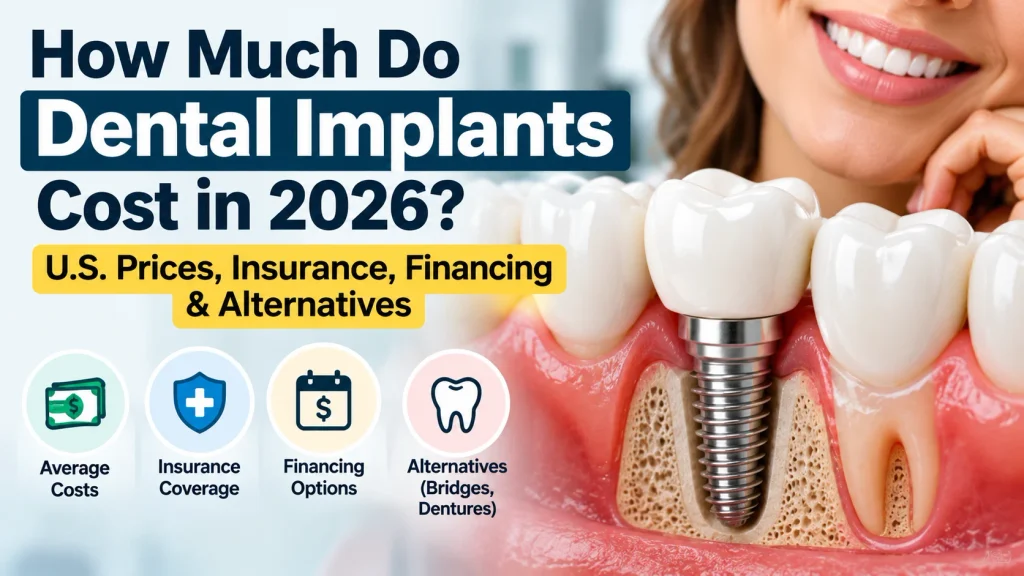
How much do dental implants actually cost in the United States in 2026?
There isn’t one universal price. The final cost can vary substantially depending on how many teeth need replacing, the type of restoration, your location, the dentist or specialist performing the procedure, diagnostic imaging, bone condition, and whether additional treatment is required.
This guide explains the major costs and options so you can better understand a dental implant estimate before making a decision.
Medical note: This article is for general educational purposes and isn’t a diagnosis or individualized treatment recommendation. A licensed dentist or dental specialist who has examined you can determine which treatment options are appropriate for you.
How Much Does a Dental Implant Cost in the U.S.?
A useful starting point is to understand what people mean when they say “the cost of a dental implant.”
CareCredit’s 2026 analysis reports an average cost of approximately $2,143 for a full-size single-tooth dental implant, with reported costs ranging from roughly $1,646 to $4,157. However, an implant quote may not necessarily represent the entire restored tooth.
A complete treatment can involve several components:
- The dental implant placed into the jaw
- An abutment that connects the implant to the restoration
- The dental crown that becomes the visible replacement tooth
- Examination and consultation
- X-rays or 3D imaging
- Tooth extraction when necessary
- Bone grafting in some patients
- Anesthesia or sedation
- Follow-up appointments
For this reason, estimates for a complete single-tooth implant restoration are often higher than the price advertised for the implant component alone.
A 2026 consumer cost analysis from SmileCosts estimates approximately $3,000–$4,500 for a complete single implant with the implant, abutment and crown, with an average around $3,750.
The important lesson is simple:
Don’t compare implant advertisements based only on the headline price.
Instead, ask exactly what is included in the quoted amount.
What Is a Dental Implant?
A dental implant is a small post—commonly made from titanium or another biocompatible material—that is surgically positioned in the jawbone to support a replacement tooth.
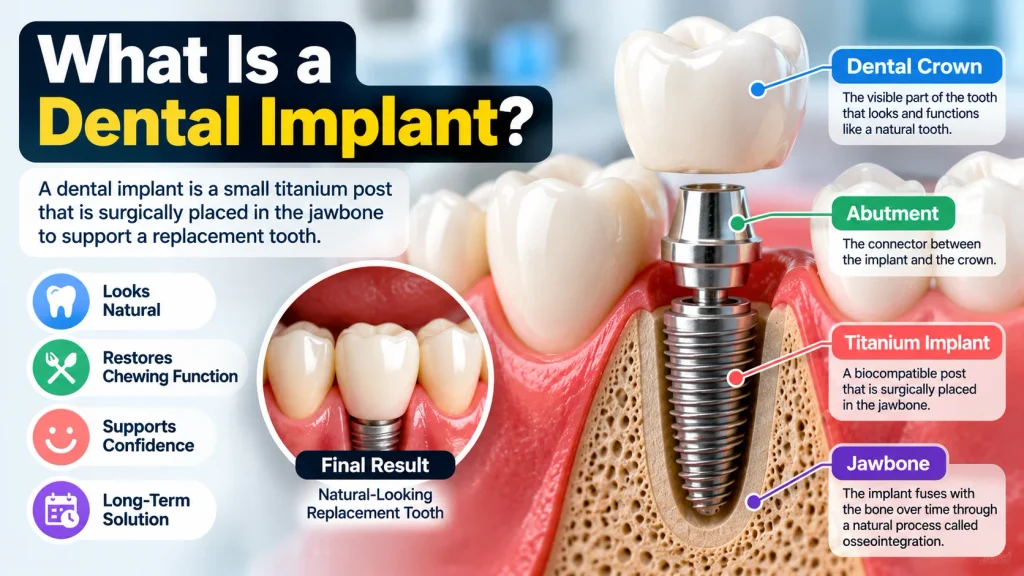
A typical single-tooth restoration has three major parts:
1. Implant
The part placed into the jawbone.
2. Abutment
The connector between the implant and the replacement tooth.
3. Crown
The visible artificial tooth attached above the gumline.
The process can take multiple appointments and, depending on the treatment plan, healing time may be required before the final restoration is completed.
That helps explain why implant treatment isn’t directly comparable to simply purchasing a crown or removable denture.
Read more: The Brain Song Reviews for Busy Moms: Is This Audio Routine Worth Your Time?
Dental Implant Cost Breakdown
Your treatment estimate may contain several separate charges.
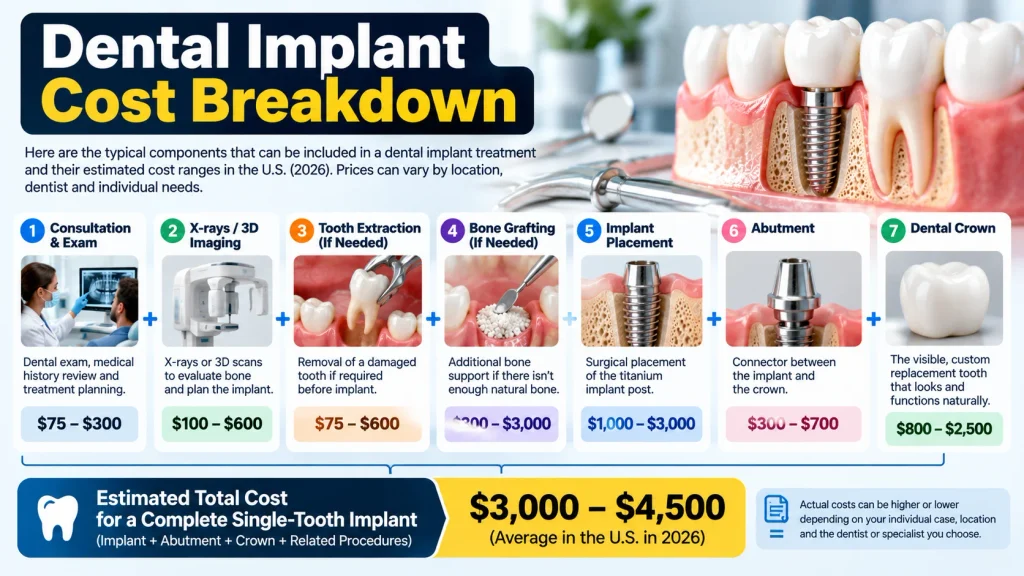
Initial Dental Implant Consultation
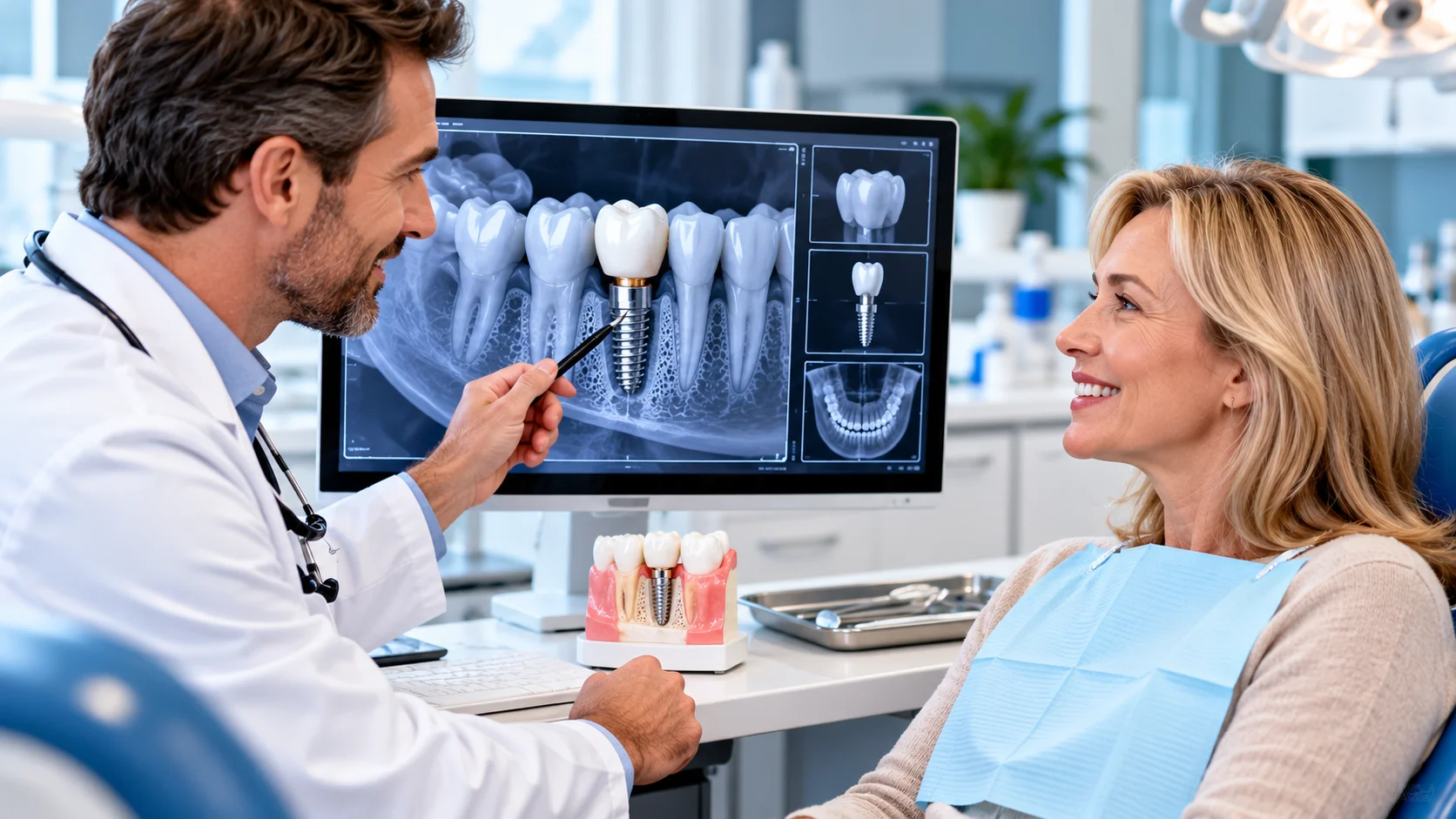
Before recommending an implant, the dental team generally needs to evaluate your teeth, gums, bite, medical history and jawbone.
The evaluation may involve conventional X-rays or more advanced three-dimensional imaging.
The consultation matters because not every missing tooth should automatically be replaced with an implant, and not every patient will have exactly the same treatment requirements.
When comparing dental offices, ask whether the consultation and imaging are included in the treatment quote or billed separately.
Tooth Extraction
If the damaged tooth is still present and cannot be restored, it may need to be removed before or as part of implant treatment.
A straightforward extraction and a complicated surgical extraction aren’t necessarily priced the same way.
Ask whether extraction is included when you receive your written treatment estimate.
Bone Grafting
Dental implants need adequate bone for support.
Some patients have sufficient bone available, while others may need bone augmentation before or during implant placement.
This can increase both the cost and the treatment timeline.
The need for grafting can’t reliably be determined from an online article or advertisement. It requires an appropriate dental evaluation and imaging.
Implant Placement
This is the surgical placement of the implant into the jaw.
Costs can vary based on the clinical situation, implant system, location and provider.
If you see an unusually inexpensive advertised implant price, determine whether it represents implant placement only rather than the completed replacement tooth.
Abutment and Crown
Once the implant is ready to support the final restoration, an abutment and crown can be used to complete a single-tooth replacement.
The crown is designed to function as the visible tooth.
Materials, laboratory work and restoration complexity can influence this portion of the cost.
Why Dental Implant Prices Vary So Much
Someone in Texas may receive a different quote from someone in New York, California or Florida even for apparently similar treatment.
Several variables can affect the final price.
Geographic location
Dental-office operating costs and local market conditions differ considerably across the United States.
Number of teeth being replaced
Replacing one missing tooth is very different from restoring an entire arch.
Bone and gum condition
Additional treatment may be necessary before an implant can be placed predictably.
Complexity
Straightforward cases and complex restorative cases aren’t priced identically.
Type of restoration
A single crown, implant-supported bridge and full-arch restoration are different procedures.
Dentist or specialist
Training, experience, practice structure and the complexity of the treatment can influence fees.
Sedation
Patients requiring additional sedation services may have additional costs.
This is why asking for a written, itemized treatment plan is more useful than comparing one advertised number.
Single-Tooth Dental Implant Cost
A single implant is commonly considered when one tooth is missing and neighboring teeth are otherwise suitable to remain intact.As discussed earlier, a complete restoration may cost several thousand dollars once the implant, abutment and crown are considered.
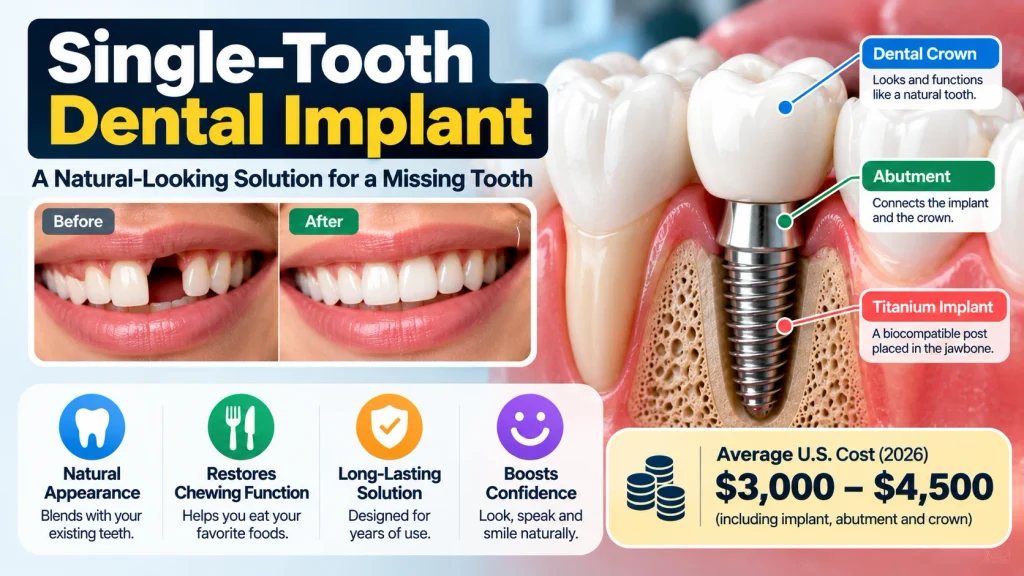
Additional procedures can raise the total.
Before agreeing to treatment, ask:
- Is the crown included?
- Is the abutment included?
- Are X-rays or 3D scans included?
- Is extraction included?
- Is bone grafting included?
- Are temporary restorations included?
- Are follow-up visits included?
- What happens if additional treatment becomes necessary?
Getting these answers in writing makes comparisons between providers much more meaningful.
What Do Full-Mouth Dental Implants Cost?
This is where online price comparisons become considerably more complicated. “Full-mouth dental implants” doesn’t necessarily mean placing one implant for every missing tooth. Different treatment plans may use several implants to support a fixed or removable full-arch restoration. Consequently, costs can reach tens of thousands of dollars, particularly when extensive treatment is required.
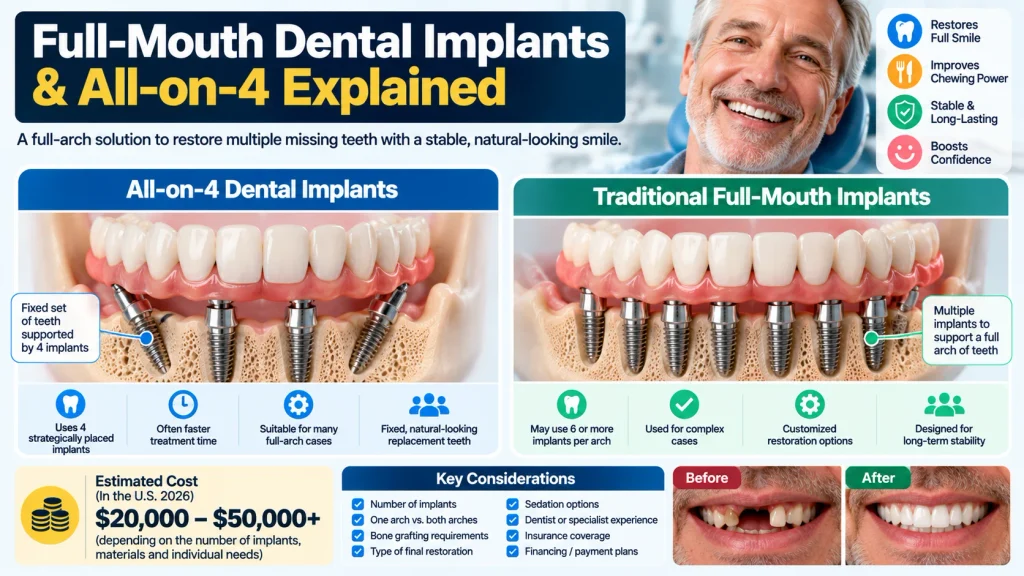
Factors may include:
- Number of implants
- One arch versus both arches
- Extractions
- Bone grafting
- Temporary teeth
- Final restoration materials
- Sedation
- Laboratory costs
- Complexity of the patient’s bite
A quote advertising a single price for “full-mouth implants” should therefore be examined carefully.
Find out exactly what treatment that price represents.
What Are All-on-4 Dental Implants?
All-on-4 is a full-arch treatment concept in which a fixed dental prosthesis is supported by four strategically positioned implants. It is different from replacing every missing tooth with its own implant. Patients researching this option may encounter terms such as:
All-on-4 implants
full-arch implants
implant-supported dentures
fixed implant bridge
full-mouth restoration
These aren’t necessarily interchangeable treatments.
If you’re considering full-arch treatment, ask the dentist exactly what type of restoration is being proposed, how many implants will be used, what materials are planned and what is included in the quoted price.
Dental Implants vs. Dental Bridges
Implants aren’t the only way to replace a missing tooth. A traditional dental bridge generally uses neighboring teeth to support a replacement tooth.
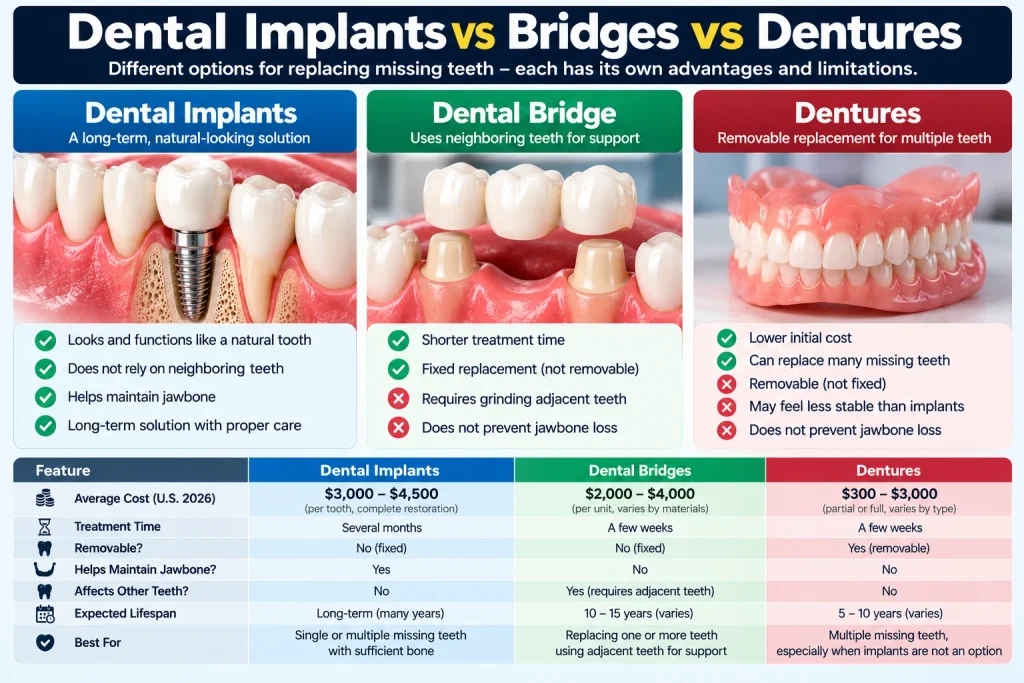
A bridge may offer:
- No implant surgery
- Potentially shorter treatment time
- A fixed replacement rather than a removable appliance
An implant may offer:
- Independent support for the replacement tooth
- No need to use adjacent teeth as bridge supports in some situations
- A treatment option designed to integrate with the jawbone
Neither option is automatically best for every person.
The condition of the neighboring teeth, bone, gums, bite, health history and budget can all influence the decision.
Dental Implants vs. Dentures
Traditional dentures remain another widely used solution for multiple missing teeth.
Dentures may have advantages such as:
- Lower initial cost than extensive implant treatment
- No implant surgery for conventional dentures
- Ability to replace many missing teeth at once
However, conventional removable dentures and fixed implant-supported restorations provide very different experiences.
Some patients may also be candidates for implant-supported removable dentures, which sit somewhere between conventional dentures and fixed full-arch restorations.
A dentist can explain which alternatives are realistic for your particular mouth.
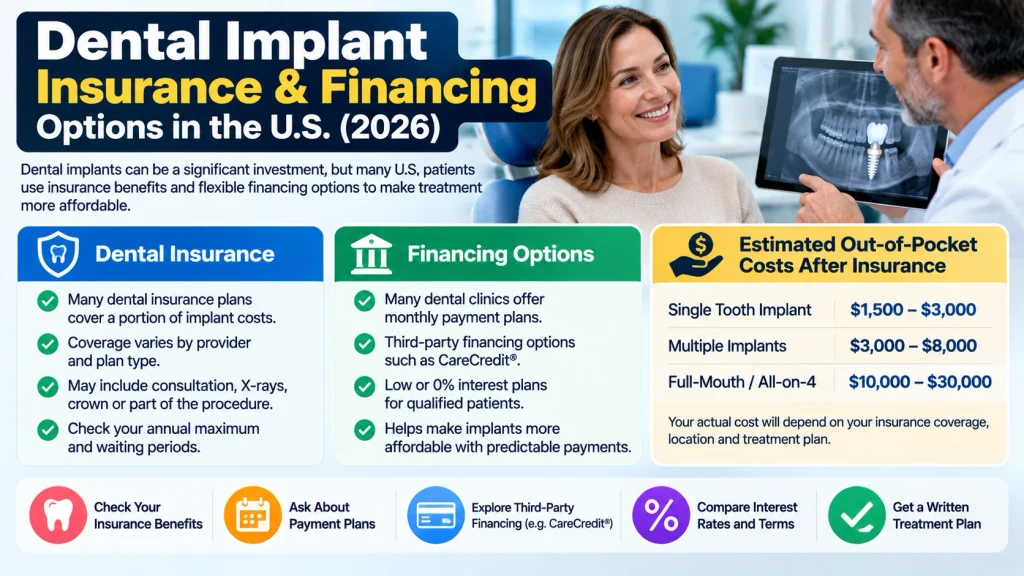
Are Dental Implants Covered by Insurance?
This is one of the most important questions for U.S. patients.
Dental insurance varies significantly by plan.
A plan might contribute toward certain parts of treatment while excluding or limiting others. Deductibles, annual maximums, waiting periods, network rules and replacement-tooth provisions can all matter.
Don’t assume that “implant coverage” means your insurer will pay the entire bill.
Before treatment, ask the dental office for an estimate showing:
Total treatment cost
Estimated insurance contribution
Your estimated out-of-pocket responsibility
You can also contact your insurer directly to confirm coverage.
Remember that an estimate of benefits isn’t necessarily a guarantee of final payment.
What If My Dental Insurance Doesn’t Cover Implants?
A lack of full insurance coverage doesn’t necessarily mean you have only two choices—pay everything immediately or abandon treatment.
Depending on the practice, patients may have access to:
- Dental-office payment arrangements
- Third-party healthcare financing
- Dental savings plans
- Health savings account (HSA) funds when eligible
- Flexible spending account (FSA) funds when eligible
- Staged treatment
- Alternative restorative options
Financing doesn’t make treatment cheaper, however.
Interest rates, promotional periods, fees and repayment terms should be reviewed carefully.
Dental Implant Financing: Questions to Ask Before Signing
Monthly payment advertising can make expensive dental treatment appear much more affordable.
But don’t evaluate financing solely by the monthly payment.
Ask:
What is the total amount financed?
What is the APR?
How long is the repayment period?
Is the promotional interest rate temporary?
Is there deferred interest?
What happens if the balance isn’t paid during the promotional period?
Are there application or account fees?
A $150 monthly payment can represent very different total costs depending on the financing terms.
How to Find Affordable Dental Implants Without Choosing on Price Alone
“Affordable” shouldn’t automatically mean selecting the lowest advertisement you can find.
Implant treatment involves surgery and long-term restorative planning.
When comparing providers, consider:
Credentials and experience
Ask who will perform each stage of treatment and what relevant training they have.
Treatment planning
A proper assessment should come before a final treatment recommendation.
Itemized pricing
You should understand what’s included and what could generate additional charges.
Follow-up care
Find out what happens after implant placement and after the final restoration is delivered.
Restoration quality
Ask what type of final restoration is planned.
Alternatives
A good consultation should help you understand reasonable alternatives, not simply pressure you into the most expensive treatment.
Be Careful With Extremely Cheap Dental Implant Advertising
A low advertised price isn’t necessarily misleading, but it may represent only one component of treatment.
For example, an advertisement may quote the implant fixture but exclude:
- Crown
- Abutment
- Extraction
- Imaging
- Bone graft
- Sedation
- Temporary tooth
- Final restoration
- Follow-up treatment
Ask:
“What is my estimated total cost from the first appointment through the completed final tooth?”
That question can make price comparisons much clearer.
Who May Be a Candidate for Dental Implants?
Dental implant candidacy is individualized.
A dentist may evaluate factors such as:
- Available bone
- Gum health
- Oral hygiene
- Overall health
- Smoking or tobacco use
- Certain medications
- Existing dental disease
- Bite and tooth position
- Ability to maintain the restoration
Having one risk factor doesn’t necessarily mean implants are impossible.
It means the treatment needs to be assessed individually.
What Happens During a Dental Implant Consultation?
If you’ve never attended an implant consultation, knowing what to expect can make the process less intimidating.
The dentist or specialist may discuss:
- Your dental concerns
- Medical and dental history
- Missing or damaged teeth
- Gum health
- Bone availability
- Imaging
- Replacement options
- Expected treatment stages
- Estimated timeline
- Costs and financing
This is also your opportunity to ask questions.
Don’t feel pressured to make a major treatment decision before you understand the plan.
Questions to Ask a Dental Implant Dentist
Consider taking a written list to your consultation.
Useful questions include:
- Why are you recommending an implant for me?
- What alternatives do I have?
- How many implants would I need?
- Do I need bone grafting?
- Who performs the surgery?
- Who makes the final restoration?
- What is included in the quote?
- What isn’t included?
- How long could treatment take?
- Will I have a temporary tooth?
- What type of anesthesia or sedation is used?
- What follow-up care is included?
- How should I maintain the implant?
- What complications should I know about?
- What is the estimated insurance contribution?
- What financing options are available?
A good consultation should leave you better informed, not more confused.
Can You Get Dental Implants in One Day?
You may see advertising for “same-day dental implants” or “teeth in a day.”
These phrases can refer to specific treatment protocols in which implants and a temporary restoration may be placed within a short timeframe for appropriately selected patients.
That doesn’t necessarily mean every part of the final treatment is permanently completed in a single visit.
Some patients require healing before receiving their definitive restoration.
Ask specifically whether an advertised “same-day” treatment refers to:
implant placement, temporary teeth, or the final permanent restoration.
Are Dental Implants Permanent?
You may encounter advertisements describing implants as permanent or lifetime solutions.
It’s better to think about them as long-term dental restorations that still require maintenance.
The implant itself, surrounding tissues and restoration need professional monitoring and appropriate home care.
Crowns and other prosthetic components can also experience wear or require repair or replacement over time.
No responsible article can tell an individual patient exactly how long their restoration will last.
Oral Care Still Matters After Dental Treatment
Replacing a missing tooth doesn’t eliminate the need to care for the rest of your mouth.
Daily oral hygiene remains important.
A basic routine commonly includes:
- Brushing appropriately
- Cleaning between teeth
- Following your dentist’s recommendations
- Regular dental examinations
- Professional cleanings as recommended
- Avoiding tobacco
- Paying attention to persistent bleeding, swelling or discomfort
If you have implants, your dental team can show you how to clean around your specific restoration.
What About Oral Probiotics and Dental Supplements?
Consumers researching teeth and gum health increasingly encounter oral probiotics, lozenges and dietary supplements marketed for oral wellness.
These products belong in a different category from professional dental treatment.
A supplement cannot replace a missing tooth, place an implant, repair a cavity, treat an abscess or substitute for professional diagnosis and treatment.
However, some consumers still choose oral-wellness products as an additional part of their everyday routine.
One commercially available product in this category is ProDentim.
ProDentim: An Optional Oral-Wellness Product
ProDentim is marketed as an oral probiotic supplement intended to support oral wellness through probiotic strains and other ingredients.
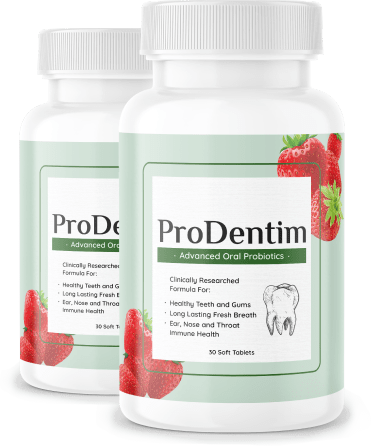
It should not be viewed as an alternative to dental implants, fillings, periodontal treatment, professional cleanings or other necessary dental care.
If you’re interested in this type of product, review the ingredients, directions, warnings and current offer before deciding whether it’s appropriate for you.
Check the Current ProDentim Offer on the Official Sales Page
Affiliate disclosure: If you purchase ProDentim through our link, we may receive a commission at no additional cost to you.
People who are pregnant or nursing, have a medical condition, take medications, or have questions about supplement use should discuss those questions with an appropriate healthcare professional.
Dental Implants vs. Daily Oral Care: Don’t Confuse the Two
This distinction deserves emphasis.
If a tooth is missing, an oral supplement does not grow the tooth back.
If you have an untreated cavity, supplement use doesn’t replace evaluation and restorative dental care.
If you have swelling, severe tooth pain, trauma or signs of infection, seek appropriate professional dental care rather than attempting to manage the problem with a wellness product.
Think of these as separate categories:
Professional dental treatment: diagnosis, fillings, crowns, implants, bridges, dentures, periodontal treatment and other clinical procedures.
Daily oral care: brushing, interdental cleaning, diet-related habits and other dentist-recommended home care.
Optional wellness products: products some consumers choose in addition to—not instead of—appropriate oral hygiene and professional care.
How to Compare Dental Implant Quotes
Suppose Dentist A quotes $2,200, while Dentist B quotes $3,800. It might appear that Dentist A is dramatically cheaper. But imagine the first quote covers only implant placement, while the second includes the implant, abutment, crown and certain follow-up services.
They’re not comparable prices.
Create a simple checklist for every quote:
| Treatment component | Quote A | Quote B |
|---|---|---|
| Consultation | Included? | Included? |
| Imaging | Included? | Included? |
| Extraction | Included? | Included? |
| Bone graft | Included? | Included? |
| Implant | Included? | Included? |
| Abutment | Included? | Included? |
| Temporary tooth | Included? | Included? |
| Final crown | Included? | Included? |
| Sedation | Included? | Included? |
| Follow-up | Included? | Included? |
This is much more useful than comparing headline prices.
Should You Travel for Cheaper Dental Implants?
Some Americans consider traveling to another city, state or country because of lower advertised dental prices.
Price is only one part of that decision.
Consider:
- Who will provide follow-up care?
- What happens if complications develop after you return home?
- How many trips are required?
- Are travel and accommodation included in your cost comparison?
- How will records be transferred?
- Who handles repairs or adjustments?
- What regulatory and professional standards apply where treatment is performed?
For extensive treatment, follow-up accessibility can be an important part of the overall value.
How to Reduce Your Dental Implant Costs Responsibly
There is no universal trick for making implant treatment inexpensive, but several steps can help you make a more informed financial decision.
Get a complete treatment plan. Know the total expected cost rather than only the surgical fee.
Understand your insurance. Verify which components may receive benefits.
Compare appropriate treatment plans. A second professional opinion can sometimes clarify your options.
Ask about alternatives. A bridge or removable restoration may be appropriate in some circumstances.
Review financing carefully. Compare total repayment rather than just monthly payments.
Ask about treatment sequencing. In complex cases, some treatment may occur in stages.
Don’t postpone urgent dental problems solely to shop for a lower price. Pain, swelling or suspected infection may require prompt professional attention.
Frequently Asked Questions
How much is one dental implant in the U.S. in 2026?
Costs vary considerably. CareCredit reports an average of about $2,143 for a full-size single-tooth implant itself, while a complete restoration involving the implant, abutment and crown can cost more. Always determine exactly what a quoted price includes.
Why are dental implants so expensive?
Implant treatment can involve surgery, diagnostic imaging, restorative dentistry, laboratory work, specialized components and multiple appointments. Additional procedures such as extraction or bone grafting can further increase costs.
Does dental insurance pay for implants?
Some U.S. dental plans may contribute toward certain parts of treatment, while others provide limited or no implant benefits. Annual maximums, deductibles and plan exclusions can significantly affect out-of-pocket costs.
Can I finance dental implants?
Many dental practices offer or accept financing options. Compare APR, repayment period, fees and total repayment—not just the advertised monthly payment.
Are cheap dental implants safe?
Price alone doesn’t establish treatment quality or safety. Instead of assuming cheap means bad or expensive means good, evaluate provider credentials, treatment planning, what the quote includes, follow-up arrangements and reasonable alternatives.
Are dental implants better than bridges?
Not necessarily for everyone. Implants and bridges have different advantages and limitations. The condition of your neighboring teeth, gums, bone, health and budget can influence which option is appropriate.
Are implants better than dentures?
They are different treatment approaches. Conventional dentures may be less expensive and avoid implant surgery, while implant-supported restorations can provide different levels of support and stability. Individual suitability requires professional evaluation.
The Bottom Line
Dental implants can be an important tooth-replacement option, but “How much is a dental implant?” doesn’t have one simple national answer.
For a single missing tooth, you may encounter prices ranging from the implant component alone to a several-thousand-dollar complete restoration. Full-arch or full-mouth treatment can cost considerably more.
Instead of choosing a provider based on the lowest advertisement, focus on understanding:
What treatment you actually need
What every quote includes
What insurance may contribute
What you’ll pay out of pocket
Whether financing increases the total cost
What reasonable alternatives exist
and
Who will provide your treatment and follow-up care.
The best next step for someone seriously considering implants isn’t buying a product online—it’s getting an individualized examination and treatment plan from a qualified dental professional.
Once you know what treatment you actually need, you can compare prices, insurance benefits, financing and alternatives much more intelligently.
Affiliate Disclosure: This article may contain affiliate links. If you purchase through one of these links, Momvity may receive a commission at no additional cost to you. Affiliate relationships do not change the importance of seeking professional dental care when needed.
Medical Disclaimer: This content is for general informational and educational purposes only and isn’t intended to diagnose, treat, cure or prevent any disease or replace advice from a dentist, physician or other qualified healthcare professional.